Is this email difficult to read? View it in a web browser. ›

The Wall Street Journal. The Wall Street Journal.
LogisticsLogistics

Sponsored by

Fuel Surcharges Hit Small Businesses; How Trump Rewrote U.S. Trade Policy

By Mark R. Long | WSJ Logistics Report


Source: U.S. Energy Information Administration

Small businesses across the U.S. are starting to feel the indirect effects of the Iran war as parcel carriers raise prices to help cover rising fuel costs.

These additional costs come as many small-business owners are still struggling to adjust to the high cost of the Trump administration’s tariffs, the WSJ Logistics Report’s Liz Young writes. Now, they are grappling with how to absorb higher fuel surcharges while trying to avoid steep price increases for customers.

Amazon will impose a temporary 3.5% fuel surcharge on independent merchants using its platform starting April 17, the Journal's Esther Fung reports. The U.S. Postal Service last week announced its first-ever temporary price increase specifically to help cover rising fuel, insurance, vehicle maintenance and other costs. FedEx and United Parcel Service are adjusting their fuel surcharges weekly based on diesel prices.

Companies that ship a large number of packages each year often negotiate lower fuel surcharges into their contracts with parcel carriers. Smaller merchants generally lack the size and scale to lock in the lowest rates, said ShipMatrix President Satish Jindel.

  • U.S. oil futures notched their biggest daily gain since they were climbing back from the Covid crash six years ago to close out a whiplash, holiday-shortened week at $111.54 a barrel.
  • The world’s largest aircraft carrier, the USS Gerald R. Ford, is set to rejoin Operation Epic Fury after a five-day port visit in Croatia for repairs and to receive supplies. (WSJ)
  • Foreign ministers from over 40 nations met Thursday in London to prepare for next week’s talks on demining the Strait of Hormuz after the Middle East conflict eases. (WSJ)
  • The containership Safeen Prestige sank in the Strait of Hormuz, a month after it was reportedly struck by at least one Iranian missile. (The Maritime Executive)
 
CONTENT FROM: PENSKE
Gain an Edge. Gain Ground With Penske.

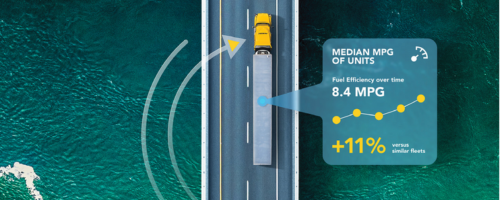
Penske’s industry-first Catalyst AI™ uses advanced algorithms and billions of data points to compare your fleet to similar fleets. This provides your business with unique benchmarks across key metrics, like fuel efficiency, fleet utilization and maintenance—giving you a personalized game plan for improvement.

Learn More


“These fuel surcharges really feel like tariffs 2.0.”

— Steven Mazur, co-founder and CEO of Ash & Erie
 

Global Trade

PHOTO: KENT NISHIMURA/POOL/EPASHUTTERSTOCK; KYLE GRILLOT/BLOOMBERG NEWS

WSJ VIDEO: A year after Trump unveiled his "Liberation Day" tariffs, WSJ's Gavin Bade breaks down how the president has remade U.S. trade policy to rely on economic coercion rather than cooperation and consent–a stark shift from the past 50 years.

  • Products that contain steel, aluminum or copper of less than 15% by weight won’t be tariffed under a new regime announced Thursday, and instead will be subject to Trump’s separate, 10% global minimum tariff. (WSJ)
  • The U.S. will impose tariffs of up to 100% on branded pharmaceuticals, though nations or drugmakers that strike deals with the Trump administration or commit to building U.S. factories can face lower levies. (WSJ)
  • Pandora opened a new distribution center in Ontario, operated by GXO Logistics, allowing the jewelry company to ship directly to Canada instead of through the U.S., in part to cut tariff exposure. (SupplyChain24/7)
 
Share this email with a friend.
Forward ›
Forwarded this email by a friend?
Sign Up Here ›
 

Img caption/IMG CREDIT HERE

The U.S. trade deficit increased in February, continuing a bumpy stretch for international flows of goods amid fast-changing U.S. policy.

February imports were $372.1 billion, up 4.3% from January. U.S. exports that month increased slightly less, by 4.2%, to $314.8 billion. That yielded a February trade deficit of $57.4 billion, up 4.9% from the January deficit.

  • Canada's trade deficit surged to a six-month high as shipments of gold drove imports to record levels. (Dow Jones Newswires)
 

Number of the Day

500 Million

Weekly production of sterile male flies targeted by the USDA to prevent flesh-eating screwworms from spreading from Mexico to threaten U.S. cattle herds


In Other News

  • U.S. jobless claims fell to 202,000 in the week through March 28, down 9,000. (WSJ)
  • South Korea’s headline inflation accelerated to 2.2% in March, driven by surging energy costs from the Iran war. (WSJ)
  • The State Department and Federal Maritime Commission said China’s detention of Panama-flagged ships appeared to be retaliation for Panama’s cancellation of CK Hutchison’s concessions to operate two port terminals. (Dow Jones Risk Journal)
  • Maine is poised to freeze large data-center construction, which would make it the first state to enact such a measure. (WSJ)
  • Federal regulators are weighing a ban on air-bag components from China’s DTN Airbag after finding the parts were to blame for a dozen crashes over the past three years, involving 10 deaths. (WSJ)
  • Tesla delivered 358,023 EVs in the first quarter, up 6.3% from a year earlier, but missed analyst estimates. (WSJ)
  • Bed Bath & Beyond agreed to acquire The Container Store and its brands Elfa and Closet Works in a deal worth $150 million. (WSJ)
  • The National Labor Relations Board ruled that Amazon must negotiate with a Teamsters-aligned union representing workers at a Staten Island warehouse. (Reuters)
  • New York-listed Scorpio Tankers reached a deal with reactor developer Ampera to collaborate and invest $10 million in exploring zero-carbon power for ships, offshore assets and ports. (Splash247)
  • Japan’s Marubeni took full ownership of DASI, a U.S. aircraft-parts inventory company. (Nikkei Asia)
 

In this week's Dow Jones Risk Journal Podcast: Federal regulators plan to take a firmer hand with prediction markets, even as they battle states for oversight authority. Also, the government is telling banks to pay attention to healthcare fraud. James Rundle hosts. You can listen to new episodes every Friday on Apple Podcasts, Spotify and Amazon.


About Us

Mark R. Long is editor of WSJ Logistics Report. Reach him at mark.long@wsj.com. Follow the WSJ Logistics Report team on LinkedIn: Mark R. Long, Liz Young and Paul Berger.

 
Desktop, tablet and mobile. Desktop, tablet and mobile.
Access WSJ‌.com and our mobile apps. Subscribe
Apple app store icon. Google app store icon.
Unsubscribe   |    Newsletters & Alerts   |    Contact Us   |    Privacy Policy   |    Cookie Policy
Dow Jones & Company, Inc. 4300 U.S. Ro‌ute 1 No‌rth Monm‌outh Junc‌tion, N‌J 088‌52
You are currently subscribed as [email address suppressed]. For further assistance, please contact Customer Service at sup‌port@wsj.com or 1-80‌0-JOURNAL.
Copyright 2026 Dow Jones & Company, Inc.   |   All Rights Reserved.
Unsubscribe