|
|
|
|
|
|
|
|
|
|
The Morning Download: Home Depot Focuses AI on Customer Experience
|
|
By Steven Rosenbush | WSJ Leadership Institute
|
|
|
|
|
|
|
Good morning. We keep coming back to the question of whether companies are driving a return on their investment in AI, and for good reason. It matters to the individual company, with broader consequences for model developers, data center builders and everyone else investing historic levels of capital into AI.
I have been posing that question directly to company leaders. Last week I spoke to The Home Depot’s Jordan Broggi about how the home improvement giant uses AI and whether it pays off. Broggi, with the company since 2013, is currently executive vice president of customer experience and president, online, responsible for customer-facing AI. Broggi, who is based in Atlanta, spoke with me during a visit to New York about how the company focuses AI on demonstrated customer needs.
Below are edited highlights of that conversation:
|
|
|
|
|
Content from our sponsor: Deloitte
|
|
|
HPE CIO on Steering Enterprise Tech Toward Business Value
|
|
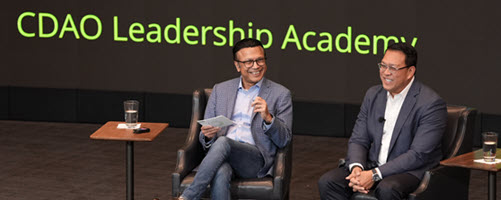
Rom Kosla says leaders should keep broader business objectives in view and ensure investments are connected to measurable value. “The question is whether the work is helping the business move in the right direction,” he says. Read More
|
|
|
|
|
|
|
|
|
|
|
|
|

|
|
Home Depot's Jordan Broggi Steven Rosenbush / WSJ
|
|
|
|
|
|
WSJ Leadership Institute: What role does AI play within Home Depot?
Broggi: It's an interesting question because there's so many layers to AI … More broadly Home Depot has been using AI in its software development and its models for 10 to 15 years at scale, in particular in our website, our search algorithms, our recommendation modules on the website. Those have been powered by AI in the models for years. More recently with generative AI and the LLMs, that has opened the door to just new things and better models.
And so as we bring that into the experience, you can generally think of it as three different ways that it plays out.
There are some experiences that are customer facing and AI is helping this experience be better. And then as a workforce, we can move faster and be more productive by using AI tools.
WSJLI: Can you walk me through some examples of what you are doing with AI?
Broggi: I think the first thing we brought out was just summarizing all the reviews on products. Ratings and reviews have been around. You start scrolling through and you have got hundreds of reviews and you're trying to look through them and you need something in [your] use case. Yeah, you can read a thousand reviews if you want. But here's a perfect use case for an LLM, summarizing information.
It's so helpful. If you think about Q&A on a website, again, it has been around for decades. Historically that went to a human and at best you might get an answer in an hour. By the time it gets answered, you've moved on. Well, we got an LLM trained on all the product documentation, all the specs, and most of those questions can just be answered in real time.
We've got a tool on the Pro version of our website where you can actually construct a materials list. Think of an e-commerce journey where let's say you're building a deck. You search, SKU by SKU … if you're doing a big multi-thousand dollar project, that could take you a lot of time to go build out that whole list. We've had shortcuts in the past. You can save the list, you'd have a template. We've got a new tool now that you can describe, hey I'm doing a 10-by-10 deck … and it'll build it out, here's the 20 things that we think you're going to need. Instead of going one by one through the catalog, we can bring that right in front of you.
And then it's a great chance to bring in recommendations. Hey, do you need gloves? Do you need safety glasses?
When we have a Pro bulky delivery--picture a big, flatbed truck full of building materials--we now can run all of those deliveries through basically an AI agent, that does two things. It looks at have we ever been to this address before, and if so, was there a problem? It also goes and looks at Google Maps. All the street view images and says, on the route that this truck is going to take, is there anything that I see visually that could be a problem again? It can identify in particular, … this road isn't even paved, there's not actually a house number here because it's a new build and it's a construction site. We've been to this condo building, you know, four times and in three of the four times, we didn't have a gate code. A human could do that, but you're looking for needles in haystacks. We've got an AI model now that runs and it flags these [are the] deliveries I'm
worried about. And then we can kick those into a manual queue and say, you better call this customer and make sure that they give you the gate code or the 36-foot truck isn't going to work because this street is way too tight. You better take the 22-foot truck.
WSJLI: Are these investments in AI driving a return for the company?
Broggi: We start with a real customer or associate application and say, how can I make this better? And so, that has helped us from an ROI standpoint because we typically plug it into … an existing use case. We are still experimenting in areas that don't always gain immediate traction and so it's a little bit balanced. But given that we're not building foundational models, which is a massive investment, and given that most of our activity is pointed at real world, existing customer problems, opportunities, etc., the ROI on it has been quite good.
|
|
|
|
|
|
|
The unemployment rate in the information-technology job market increased to 3.8% in April from 3.6% in March, according to analysis from consulting firm Janco Associates, which bases its findings on data from the U.S. Labor Department. The WSJ Leadership Institute's Belle Lin has the story.
|
|
|
|
|
The information sector lost 13,000 jobs in April. While it’s still too early to say exactly how AI is affecting employment overall, some businesses, especially in the tech industry, have said it’s part of the reason they’re cutting staff.
Inflation and economic uncertainty linked to the Iran conflict is also giving some chief executives and tech leaders reason to pull back or pause their IT hiring, said Janco Chief Executive Victor Janulaitis.
For companies that are hiring, the demand has become more selective.
Postings for developer jobs are up 15% year-over-year on job-search platform Indeed, Hannah Calhoon, its vice president of AI, tells Belle. "A lot of people are looking to hire engineers who already have experience.”
Manu Narayan, chief information officer of GitLab, said the software development tools maker will see change in its entry-level IT roles, but early-career workers will have an opportunity to build the AI agents and workflows.
“We see the shape of hiring changing some of these skills and backgrounds, but at the same time, we don’t see it dislocating the need for having great individuals with deep, critical-thinking skills,” Narayan said.
|
|
|
|
|
|
|
|
|
Conversations brought to light in the wake of Elon Musk’s lawsuit against OpenAI, including this exchange between OpenAI CEO Sam Altman and former CTO Mira Murati after his 2023 firing, have provided online fodder for the meme machine. Here is one take from Eureka Health co-founder @SinaHartung.
|
|
|
|
|
|
|
|

|
Insight Enterprises Chief Executive Jack Azagury
|
|
|
|
|
Closing the mid-market's AI gap. Insight Enterprises, an $8.2 billion company that provides hardware, software and IT services, earlier this year named long-time Accenture veteran Jack Azagury as chief executive.
Azagury talked recently with the WSJ Leadership Institute about the company’s pivot towards becoming an AI solutions integrator and the AI challenges facing mid-market businesses, where less than 30% have fully integrated AI into their operations.
|
|
|
|
Insight defines companies in the mid-market as $500 million and up to $3 to $5 billion in top-line revenue.
Here are edited highlights from the discussion.
|
|
|
WSJ: What are the challenges your mid-market customers, your potential customers, face with integrating AI?
Azagury: This is a market that is not as well served as the Fortune 500 and doesn't have the resources, especially in the space of AI... How do you move fast when you may not have the 10s or hundreds of millions of dollars available that a Fortune 500 may have?
WSJLI: You mentioned that another challenge facing this market is connecting AI with a business case.
Azagury: If you look at the mid-market, less than 30% have it fully integrated into their operations. And so there's a lot of work to do to really embed it.
Very few companies have discipline around the business case… And what you often hear as well, I know what the technology can do, but I'm not yet sure what I'm going to get. So let me build it and then I'll give you a business case. And that doesn't work.
WSJLI: Are they looking for end-to-end transformation or something more modular?
Azagury: Our value proposition is that we can get you from A to Z in an integrated, seamless manner. We can figure out what hardware, what cloud subscription,how are you going to build your AI stack, where's your data going to live, you know, what application sits around it, and then implement it all with you in a seamless manner and take a lot of the headaches away.
WSJLI: How do you do that?
Azagury: We've been building a lot of skills for the last few years, organically and inorganically, a number of acquisitions in the Google space, the Microsoft space, and a number of companies we've bought with deep AI skills over the last years. And we've been focused on integrating that end-to-end seamlessly so that our teams can go out to clients and bring an end-to-end solution.
And the other thing that we do, we've been implementing, like most companies, but very aggressively implementing AI internally. We have an AI training solution here, which we now sell to clients.
WSJLI: What lessons do you take to customers to help them scale AI?
Azagury: The first thing is getting the governance right. Who's in charge of AI?...
The second thing you need to get right with the governance is some ideas you're going to drive top down… So we're going to take these two or three mega processes and they've cut across departments and we're going to transform them and we're going to take the cost or the performance from X to Y.
Then you have a lot of bottom-up initiative. You're going to have people all over the organization that are creating agents, custom GPTs, clever prompts. You want that bottom-up to surface out and that central team to curate it and find the best of the best and then disseminate it.
So how do you get that governance to drive the top-down efforts and encourage the bottom-up efforts? And have both of them flourish at the same time in the organization?...
And so getting that governance and not having conflicts in terms of who's accountable… One training program, one AI stack, a core team of core engineers, a few key partnerships of companies, hopefully like ourselves that you work with, that's a central team. And then they work with the business and you have the top-down motion and the bottom-up motion.
— Tom Loftus
|
|
|
|
|
|
-
In a preview of the wealth creation expected when OpenAI and Anthropic eventually go public, OpenAI last October allowed employees to sell up to $30 million worth of shares each in a recent financing, with over 600 collectively making $6.6 billion
-
OpenAI is negotiating with the European Union to grant access to its new cybersecurity AI model, GPT-5.5-Cyber, CNBC reports, even as Anthropic continues to withhold preview access to its competing Mythos model.
-
SoftBank has launched a battery business to supply electricity for its AI data centers and address surging power demand from the AI boom, as part of its broader strategy to become a key player in the global AI infrastructure supply chain.
|
|
|
|
The WSJ Technology Council
|
|
|
The WSJ Tech Council brings together CIOs, CTOs and CISOs advancing innovation and shaping the future. Join this trusted community where tech executives connect with peers to explore emerging trends and gain the perspective they need to stay ahead of disruption.
Request Information
|
|
|
|
|
|
|
|
|
Follow Isabelle Bousquette on LinkedIn, Instagram, X, and TikTok for more behind the scenes on her tech and AI coverage, and lately, her contributions
to the WSJ Leadership Institute's new Executive Resilience series, where she's profiling America's top execs about their fitness and wellness habits.
Follow Belle Lin on LinkedIn and X for her latest reporting on enterprise technology and AI.
Steven Rosenbush is chief of the enterprise technology bureau at the WSJ Leadership Institute. He also has a column. You can follow him on LinkedIn.
Tom Loftus is the editor of The Morning Download. He suggests following Isabelle, Belle and Steve on their various social channels. But if you insist, here's his LinkedIn.
|
|
|
|
|
|
|
|