|
|
|
|
|
|
|
|
|
|
The Morning Download: Pokémon Tests AI’s Intelligence
|
|
By Steven Rosenbush | WSJ Leadership Institute
|
|
|
|
|
|
|
Here's what's up for Jan. 22, 2026.
• Apple 'pins' hopes on AI Revamp
• Space X has plans for data centers in space
• Uber CEO says AI gains require scrapping legacy systems
|
|
|
|

|
|
Pokémon is one of the latest in a line of games tech companies have used to test their AI models. Thomas Lechleiter/WSJ
|
|
|
|
|
|
Good morning. You have heard of the Turing Test, no doubt. It was conceived more than 75 years ago as a way to test machine intelligence. Well, we have a new benchmark, the Pokémon test.
Among the world’s top AI labs, Nintendo’s original Pokémon games are emerging as a popular way to track the progress and abilities of AI models and figure out how to deploy them toward time-consuming complex goals, the WSJ Leadership Institute’s Isabelle Bousquette reports today.
A whole bunch of nerds. “It provides us with like this great way to just see how a model is doing and to evaluate it in a quantitative way,” said David Hershey, applied AI lead at Anthropic, the startup best known for its Claude chatbot. He’s the architect of the “Claude Plays Pokémon” stream on the live-gaming platform Twitch that launched last February and that inspired similar streams featuring OpenAI and Google models.
The streams tap into a long tradition of using games to test and evaluate AI. A decade ago, Google’s AlphaGo beat a human champion at the game of Go. Poker, chess and more recently videogames like Minecraft also have been used to test AI. Google subsidiary Kaggle even launched a “Game Arena,” an open-source platform that evaluates AI models through competitive games. Its inaugural event was a chess tournament in August won by OpenAI’s o3 model.
Traditional benchmarking systems typically involve asking a model individual questions and evaluating its individual answers, said Graham Neubig, associate professor at the Carnegie Mellon University Language Technology Institute.
Pokémon is different, he said, because it can track a model’s reasoning, decision-making and progress toward a goal over a long period, which is a closer analogy to the types of tasks users are aiming AI at today.
And there’s another important reason why Pokémon is so popular. “We’re all a whole bunch of nerds,” said Hershey.
Are you a nerd? Connect with us using the links at the end of this email and tell us about it.
|
|
|
|
|
Content from our sponsor: Deloitte |
 |
|
Nuveen CFO on Elevating CIO-CFO Strategic Partnerships |
|
Seun Salami discusses redefining the CFO’s role in technology strategy, from driving collaboration with CIOs to rethinking investment value in the digital age. Read More
|
|
|
|
|
|
|
|
|
|
|
|
|
|
WSJ Leadership Institute President Alan Murray is on the ground in Davos, interviewing corporate leaders on topics ranging from managing AI to geopolitical risk and how C-suite leaders are navigating market conditions.
|
|
|
🎥 Watch video highlights of Alan's conversations below:
|
|
|
|

|
|
Photo: Michael Claudio/WSJ
|
|
|
|
|
|
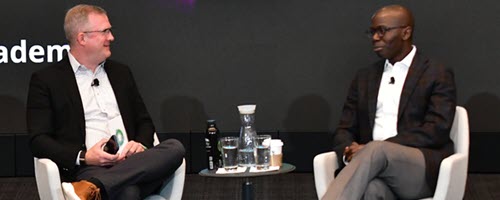
🎥 Uber CEO Says Real AI Gains Require Scrapping Legacy Systems. Uber is replacing older models used for pricing, matching and routing, Dara Khosrowshahi told Alan. “We actually often have to throw away the entire process that we've developed over the last 15 years and rebuild it from the ground up using AI,” he said. “Companies are quite conservative. Enterprises don't want mistakes being made inside the enterprise … So they go for the small game… What we've learned internally is sometimes you have to throw everything away and start from scratch from the ground up to truly get the power of AI in the enterprise."
AI at the wheel. “Now we are empowering AIs. We're throwing away all the rules and we're telling the AI, use your common sense,” Khosrowshahi told Alan. “What should we do in the circumstance when Alan, God forbid, got his burgers late? What would you do? That AI is actually much more powerful rather than just telling the AI to follow the rules because the rules are kind of an average approximation of what you think the best situation is.”
|
|
|
|
|
|
|
|
Also Heard at the World Economic Forum
|
|
|
|

|
|
Sectors like energy or semiconductors—both key to developing and harnessing the technology—were already growing thanks to AI, Jensen Huang said. Fabrice Coffrini/Agence France-Presse/Getty Images
|
|
|
|
|
|
Nvidia CEO Jensen Huang at Davos pushed back on the notion of an AI Bubble, saying that companies across sectors are already seeing growth thanks to AI.
“The AI bubble comes about because the investments are large, and the investments are large because we have to build the infrastructure necessary for all of the AI layers,” he said Wednesday.
If anything, more power and skilled workers are needed for AI’s rollout, “the single largest infrastructure buildout in human history,” he said.
Earlier this week at Davos Microsoft CEO Satya Nadella dismissed bubble concerns, but with a caveat, saying that success depended on AI’s benefits moving beyond tech companies and across industries and outside the developed world, the FT reported. “It requires that the benefits of this are much more evenly spread,” he said, according to the FT.
|
|
|
|
More on That Infrastructure Buildout
|
|
|
|

|
|
A Microsoft data-center campus in Mount Pleasant, Wis. Audrey Richardson/Reuters
|
|
|
|
|
|
A week after Microsoft pledged to pay electricity rates to cover the costs of its data centers so they aren’t passed on to consumers, OpenAI made a similar offer, promising to work with local communities where it has a data center project, Bloomberg reports.
Rising concern that the AI data center buildout is pushing up utility bills for residents reached the White House earlier this month with President Trump calling upon technology companies to “‘pick up the tab’ for their power consumption,” the WSJ reported earlier.
|
|
|
|
|
🎧 The Power Grid's AI Problem The explosive growth of AI is straining the U.S. power grid and driving up electricity prices. Tech giants and politicians are scrambling to determine who will pay for the massive infrastructure needed to keep the lights on. WSJ's Jennifer Hiller explains what this energy crisis means for the future of the power industry.
|
|
|
|
|
|
The idea of launching data centers into space is driving Elon Musk’s push to take SpaceX public, the Journal reports. Musk has become fixated on making SpaceX the first mover, people familiar with the matter said. Pulling it off would require the billions an IPO could generate in a single shot.
A breakthrough. SpaceX had been developing technology suited for an AI satellite network for years, former employees say. This fall, it made a key breakthrough in figuring out how to build and deploy data centers in orbit, according to people familiar with the effort.
Competitors pushing forward, too. OpenAI's Sam Altman investigated partnering with or acquiring Stoke Space, a startup rocket maker, over the summer. During an event in Italy in October, Jeff Bezos said that shifting data centers to orbit made sense.
|
|
|
|
|
|
|
“He’s an idiot. Very wealthy, but he’s still an idiot.”
|
|
— Ryanair CEO Michael O’Leary on Elon Musk. The two billionaires are in the middle of an online tiff, the WSJ reported.
|
|
|
|
|
|
|
|
Apple 'Pins' Hopes on AI Revamp
|
|
|
Apple’s long-awaited AI revamp will include transforming its Siri digital assistant into a chatbot embedded across Apple’s operating systems, Bloomberg reports. The company plans to unveil the chatbot, codenamed Campos, at its June developer conference. Apple this month announced that it had selected Google’s Gemini model to power its AI efforts.
|
|
|
Advances in software defined artificial intelligence progress for years. Then GPUs unlocked the next wave, unleashing billions in spending on chips, switches and interconnects to squeeze out more performance. Now, after stalls and false starts, a new era of device-level AI may finally be taking shape.
The Information reports that Apple is developing an AI wearable badge equipped with cameras, a mic and a speaker. Details remain sparse—and the project could still be scrapped—but the effort aligns with moves from Google, Meta and OpenAI, all racing to bottle a bit of AI’s magic into dedicated hardware.
|
|
|
|
The WSJ Technology Council Summit
|
|
|
This February 10–11, technology leaders will gather in Palo Alto for The WSJ Technology Council Summit to explore the realities of enterprise AI, the evolving role of tech leadership and the urgency behind building meaningful, business-driving AI strategies. Join the Technology Council and be part of the conversations shaping the future of corporate innovation.
Request Information
|
|
|
|
Everything Else You Need to Know
|
|
|
|
Trump's about-face on Greenland followed days of back-channel conversations between him, his advisers and European leaders, including NATO Secretary-General Mark Rutte and German Chancellor Friedrich Merz. (WSJ)
The Trump administration is asserting new powers to forcibly enter the homes of people they are hoping to arrest without a criminal warrant signed by a judge, according to people familiar with the matter. (WSJ)
Supreme Court justices across the ideological spectrum expressed deep unease on Wednesday about President Trump’s attempt to fire a member of the Federal Reserve, with several stressing the importance of a central bank insulated from political pressure. (WSJ)
The stark contrast between near-record profits and sharp rate hikes has put the insurance industry in the regulatory firing line. Insurers are starting to feel the heat from the political wrangle over affordability. (WSJ)
|
|
|
|
|
|
|
|
|
|
|
|
|
|