Is this email difficult to read? View it in a web browser. ›

The Wall Street Journal. The Wall Street Journal.
LogisticsLogistics

Sponsored by

Tariffs Choke U.S.-China Trade; Why Coffee Prices Keep Climbing

By Liz Young | WSJ Logistics Report


The Port of Los Angeles. PHOTO: DAMIAN DOVARGANES/ASSOCIATED PRESS

Nearly a year after President Trump announced his “Liberation Day” tariffs, trade between the world’s two largest economies has plunged to levels not seen in decades.

For much of 2025, the U.S. and China were locked in a bruising tit-for-tat trade war. The WSJ’s Hannah Miao and Roque Ruiz write that the U.S. goods trade deficit with China shrank 32% to $202 billion last year, the narrowest since 2005, according to the Census Bureau.

Still, the overall U.S. goods trade deficit rose for the year as importers shifted to markets such as Mexico, Vietnam and Taiwan. China made up for lower U.S. demand by boosting exports elsewhere.

Certain goods continued to flow between the two countries. China’s share of U.S. consumer-electronics imports plunged, but it dominated rare-earth minerals that are crucial to making a range of goods. China bought less agricultural and energy products from the U.S., while boosting purchases of aircraft.

For every $100 that American importers spent on goods last year, about $9 went to buy products made in China, the lowest proportion since China joined the World Trade Organization in 2001. As recently as 2018, the equivalent figure was above $20.


Quotable

“The supply chains that are really difficult to move—those are the ones that are still stuck.”

—Chad Bown, a senior fellow at the Peterson Institute for International Economics.
 
CONTENT FROM: PENSKE
Gain an Edge. Gain Ground With Penske.

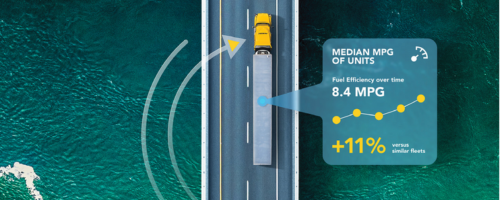
Penske’s industry-first Catalyst AI™ uses advanced algorithms and billions of data points to compare your fleet to similar fleets. This provides your business with unique benchmarks across key metrics, like fuel efficiency, fleet utilization and maintenance—giving you a personalized game plan for improvement.

Learn More


Commodities

Coffee is weighed and packaged at Reverie Coffee in Wichita, Kan. PHOTO: DAVID ROBERT ELLIOTT FOR WSJ

Your morning cup of coffee isn’t getting cheaper anytime soon. To drill down into why retail coffee prices are climbing, the WSJ’s Inti Pacheco took a deep dive into the expenses of Reverie Roasters, a Kansas roastery with two coffee shops.

Owner Andrew Gough said he didn’t have to think much about the price of coffee for more than a decade. But last year, the price of the unroasted green coffee Reverie buys jumped to $4.30 a pound from $2.41 a few months before.

Extreme weather such as droughts in Brazil and Vietnam had hit coffee crops. Later in the year, President Trump slapped steep tariffs on goods from Brazil. The cost increases were a particular challenge for small businesses like Reverie that don’t have the pricing power to buy coffee in massive volumes.

Gough said so far he has absorbed roughly half of the increased costs—because passing it to consumers is risky, too.


Share this email with a friend.
Forward ›
Forwarded this email by a friend?
Sign Up Here ›
 

Number of the Day

116.2

The American Trucking Associations for-hire truck tonnage index for February, up 2.6% from January and 2.1% compared with 2025, the largest annual gain since October 2022.


In Other News

U.S. consumer sentiment fell in March. (WSJ)

China opened two probes into U.S. trade practices. (WSJ)

Farmers and processors are poised to benefit from rules requiring more biofuels for use at the nation’s gas stations and truckstops. (WSJ)

Fertilizer maker Yara International said farmers are likely to scale back fertilizer purchases amid surging prices. (WSJ)

Owners of at least 11 warehouses sold their properties to U.S. Immigration and Customs Enforcement in recent months. (WSJ)

Absolut vodka maker Pernod Ricard and Jack Daniel’s maker Brown-Forman are in talks to combine. (WSJ)

Two containerships belonging to China’s state-owned Cosco Shipping were turned back from crossing the Strait of Hormuz. (WSJ)

A surge in detentions of Panama-flagged vessels in China appears tied to a court ruling over control of port terminals at the Panama Canal. (Reuters)

Intra-Asia carriers placed a flurry of new vessel orders over the past month totaling more than $1 billion. (Journal of Commerce)

Investment firm Lone Star completed its takeover of U.S. airport services provider and ground handler Alliance Ground International. (Air Cargo News)

A federal judge ordered the American Trucking Associations to pay the state of Rhode Island $200,000 in an ongoing fight over truck tolls. (WJAR)

Hub Group received a delinquency notice from Nasdaq for missing the deadline to file its full-year financial results after finding a $77 million accounting error. (Trucking Dive)

Prologis secured approval to convert a 1 million-square-foot warehouse in Allen Township, Pa., into a data center. (WFMZ)


About Us

Mark R. Long is editor of WSJ Logistics Report. Reach him at mark.long@wsj.com.

Follow the WSJ Logistics Report team on LinkedIn: Mark R. Long, Liz Young and Paul Berger.

 
Desktop, tablet and mobile. Desktop, tablet and mobile.
Access WSJ‌.com and our mobile apps. Subscribe
Apple app store icon. Google app store icon.
Unsubscribe   |    Newsletters & Alerts   |    Contact Us   |    Privacy Policy   |    Cookie Policy
Dow Jones & Company, Inc. 4300 U.S. Ro‌ute 1 No‌rth Monm‌outh Junc‌tion, N‌J 088‌52
You are currently subscribed as [email address suppressed]. For further assistance, please contact Customer Service at sup‌port@wsj.com or 1-80‌0-JOURNAL.
Copyright 2026 Dow Jones & Company, Inc.   |   All Rights Reserved.
Unsubscribe