Latest WASH news from WHO
No images? Click here


In this issue:
- New technical note: IPC and WASH measures in health-care settings and shelters/congregate settings in Gaza
- Big reception for new WHO guidelines and tools for small water supplies
- 'Water for Peace' campaign gains traction ahead of 22 March World Water Day
- WHO WASH Unit head is new UN-Water Vice-Chair
- Join today: webinar on empowering the next WASH systems leaders
- Personal protective equipment for sanitation workers at fecal sludge management plants in Uganda
- News briefs
New technical note: IPC and WASH measures in health-care settings and shelters/congregate settings in Gaza
The situation in the Gaza Strip is dire, with high infectious disease rates amid conflict-related challenges like overcrowding, poor sanitation and a struggling health system.
A new technical note highlights the necessity of Infection Prevention and Control (IPC) and Water, Sanitation and Hygiene (WASH) strategies. Key measures include ensuring access to clean water, promoting hand hygiene, providing IPC supplies, and adhering to cleaning protocols in health care settings.
Co-published with UNICEF, the guide aims to mitigate disease spread, considering the area's unique constraints, and will be updated as needed.

Big reception for new WHO guidelines and tools for small water supplies


The 15 February launch of new WHO guidelines and tools to improve small water supplies found a receptive audience for these much-needed resources. Since the launch, nearly 10,000 copies of the Guidelines for drinking water quality: small water supplies, and associated Sanitary inspection packages, have been downloaded. In addition, more than 1,000 people participated in an online global webinar.
These Guidelines offer authoritative guidance that is rooted in the principle of progressive improvement and built on WHO's 60-year history of shaping drinking-water quality standards. State-of-the-art recommendations and implementation guidance are provided, drawn from a comprehensive evidence review and established good practices. Additionally, case examples are provided from countries and areas around the world to demonstrate how the guidance in this publication has been implemented in practice in a wide variety of contexts.
WHO and partners are currently planning a number of follow-up activities to the launch, including webinars on specific aspects of the Guidelines and Sanitary inspection packages. Stay tuned for more information and see these additional resources:
'Water for Peace' campaign gains traction ahead of 22 March World Water Day

As the world gears up to commemorate World Water Day on 22 March, UN-Water has released campaign materials under the theme for this year, 'Water for Peace'.
The 'Water for Peace' campaign serves as a call to action for individuals and entities to unite in safeguarding our most precious resource. As the world faces mounting challenges related to water management, this initiative highlights the crucial role of cooperation in building a sustainable future for all. Participants are encouraged to download resources, join in activities and spread the message of water cooperation.
Additionally, valuable insights into drinking-water safety and quality are provided through resources offered by WHO.
Join the movement today and be part of the solution towards a more peaceful and water-secure world.
WHO WASH Unit head is new UN-Water Vice-Chair
UN-Water, the coordinating mechanism for United Nations' water and sanitation efforts, has appointed Bruce Gordon as its new Vice-Chair.
Gordon, who leads WHO's Water, Sanitation, Hygiene and Health Unit, was elected in January to contribute his expertise to UN-Water's mission. Serving in a personal capacity, his role aims to enhance collaboration among UN-Water members to address global water and sanitation challenges effectively. He will work with the new Chair of UN-Water, Alvaro Lario, President of the International Fund for
Agricultural Development (IFAD), and UN organizations to conclude the UN-System Wide Strategy for Water and Sanitation and develop its collaborative implementation plan.

Join today: webinar on empowering the next systems leaders

Water, sanitation and hygiene (WASH) systems, including on governance, monitoring, human resources and finance, are required to sustain and extend WASH services and systems to all, and especially to the most vulnerable population groups.
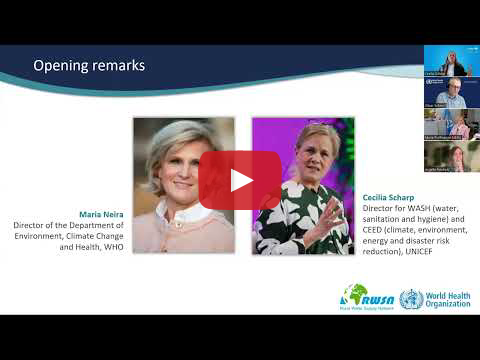
Today, at 14:00 CET (click here to convert to your time zone), an open webinar entitled "Empowering the Next Systems Leaders," will present a dialogue on WASH systems thinking and launch three free online courses designed to drive systems strengthening and positive change towards universal access.
WHO's Fiona Gore, the Lead for the UN-Water Global Analysis & Assessment of Sanitation & Drinking-water (GLAAS), will provide scene-setting remarks. Key insights will be offered by Cecilia Scharp of UNICEF, Patrick Moriarty of IRC, and Kate Harawa from Water for People. The webinar is arranged by UNICEF, IRC WASH, Water for People and the Stockholm International Water Institute (SIWI).
Personal protective equipment for sanitation workers at fecal sludge management plants in Uganda

By Mr. Douglas Bulafu, Research Associate, Department of Disease Control and Environmental Health at Makerere University School of Public Health, Uganda
Although sanitation workers provide a fundamental environmental health service to society, their occupation exposes them to extreme health and safety hazards including social discrimination and stigma.
To provide support to sanitation workers, the Department of Disease Control and Environmental Health at Makerere University School of Public Health carried out a study to understand the awareness of occupational biological risks and the use of Personal Protective Equipment (PPE) by sanitation workers in fecal waste management plants in nine cities in Uganda.
Editor's note: WHO is a founding member of the Initiative for Sanitation Workers (ISW), and the blog from Mr. Bulafu, a 2023 UNC Sanitation Workers Research Award recipient, is part of the ISW blog series entitled "Researchers for Sanitation Workers’ Rights."
News Briefs
- To help fill data gaps in sanitation services, a collaborative effort involving the WHO/UNICEF Joint Monitoring Programme for Water Supply, Sanitation and Hygiene, UN-Habitat and npj Clean Water is underway to compile a collection of papers for publication in npj Clean Water, an open-access journal, with the submission deadline extended to 1 May 2024. Accepted papers will be freely accessible online and gathered on a dedicated webpage. Learn how to submit a paper here.
- WASH Reflections: Report from Dnipro, Ukraine by Dr. Margaret Montgomery, WHO WASH in Health Care Facilities Lead, highlights a training event co-facilitated by WHO in Eastern Ukraine during the week of 22 January 2024, aimed at improving water, sanitation, hygiene, waste management, and infection prevention in health care facilities. Read Dr. Montgomery's blog for more insights, or watch this short video.
The WASH unit of WHO invites you to submit photographs for a competition, aiming to showcase images in our forthcoming publications. We seek photographs that capture the essence of quality care, embody climate resilience and represent the principles of Gender Equality, Disability Inclusion, and Social Inclusion (GEDSI). Share your perspectives and have your work featured in our global publications. Send us your submission by Friday 9 March to Nadia Abdalla (abdallan@who.int).
Did you miss the recent webinar on costing and budgeting for WASH in health care facilities? Don't worry: you can see it here.


