|
|
|
|
|
|
|
|
|
|
The Morning Download: Graphon Says Its ‘Intelligence Layer’ Will Lighten the Load on AI Models
|
|
By Steven Rosenbush | WSJ Leadership Institute
|
|
|
|
|
|
|
|

|
|
Graphon AI co-founders, from left: Deepak Mishra, chief operating officer; Arbaaz Khan, chief executive, and Clark Zhang, chief technology officer. Shefali Parekh Photography
|
|
|
|
|
|
Good morning. AI models have scaled to incredible size, but still face limits on the amount of data they can process at once. As a result, companies are sitting on massive amounts of data that their AI can’t fully understand, Arbaaz Khan, a founder and CEO of Graphon AI, told me.
Khan, a former Amazon senior applied scientist who developed customer-service platform models, says he has created a new way to address that problem. Graphon is designed to make large language models more capable by creating a so-called intelligence layer that sits between data and the LLM.
Graphon emerged from stealth today with $8.3 million in seed funding to build its class of AI infrastructure. The round was led by Arvind Gupta of Novera Ventures, with participation from Perplexity Fund, Samsung Next, GS Futures, Hitachi Ventures, Gaia Ventures, B37 Ventures and Aurum Partners. The company is based in San Francisco. Read the full story here.
|
|
|
|
|
Content from our sponsor: Deloitte
|
|
|
The Moment for Physical AI May Be Closer Than You Think
|
|
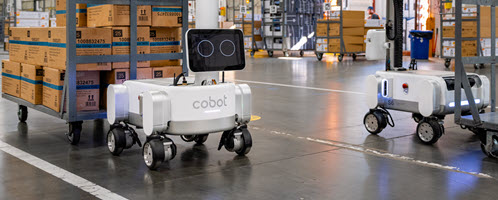
Cobot CEO Brad Porter says all the physical work that people tune out is where the biggest opportunity in physical AI is hiding—and companies that surface it first will build an advantage. Read More
|
|
|
|
|
|
|
|
|
|
|
|
The idea is to map the relationships across all sorts of data, from video to documents and systems, and real-world data, instead of having the LLM do it. And he says the new approach—based on applying smaller models to smaller chunks of data—is cheaper than processing all of the information in a massive LLM over and over again.
It’s an early-stage company, but reflective of an environment in which experienced developers who break off from established labs to test big ideas on their own are able to scale startups at an increasingly rapid pace.
AI is a moving target, and to stay current, business leaders need to stay on top of the new ideas that are emerging in the field. All of the other dimensions of AI, from leadership to investment and the economy, are downstream from the technology itself.
“We’ll go build this big relational representation that will use the property of the graphon and will find these similar ‘neighborhoods’ of data and that is what is going to feed the model, instead of having the model do all of the heavy lifting of looking at all of the data,” Khan said.
It’s also a massive savings in terms of efficiency and compute, according to Khan. The approach uses a relatively small model to process tiny chunks of data. “So it’s a lot more efficient to run this 200 million [parameter model] a thousand times than it is to try and run like a 5 trillion [parameter model] for one hour,” he said.
The ability to work with larger volumes of data will be helpful as companies look beyond the application of AI to text, and unlock insights from voice and video.
|
|
|
|

|
|
Ally Kim, vice president at Korean conglomerate GS, has incorporated Graphon AI's intelligence layer into its work. Steven Rosenbush/WSJ Leadership Institute
|
|
|
|
|
|
GS, the Korean conglomerate, has employed Graphon within its 52g initiative, which focuses on digital and AI transformation, design thinking, prototyping and user experience across GS’s many lines of business, from convenience stores to oil refining. GS Futures, a Graphon investor, is an investment arm of the GS conglomerate.
GS Vice President Ally Kim, who leads 52g, said the team used Graphon to improve analysis of closed-circuit television recordings that monitor construction sites for safety compliance. And instead of having people spend hours watching raw video footage to vet candidates for a GS-sponsored soccer team, it used Graphon to more efficiently analyze player movements, strengths and weaknesses across various situations.
“We really need to expand our knowledge scope to multimodalities, like voice or video or other contexts. Graphon can be good support,” she told me during a meeting at company headquarters in Seoul.
|
|
|
|
|
|
|
|

|
|
A Claude Cowork demonstration taking place at Anthropic’s workshop in San Francisco earlier this month. Jason Henry for WSJ
|
|
|
|
|
|
Anthropic and PwC target business AI customers. Anthropic and PricewaterhouseCoopers expanded their partnership, the companies said Thursday, with plans for the consulting firm to train and certify 30,000 of its employees on Anthropic’s flagship product Claude.
The firms declined to share the financial terms behind their deal.
Phil Samenuk, Anthropic’s head of partnerships, told The Wall Street Journal Leadership Institute that its PwC alliance “is among the largest commitments we've made with any partner.”
The expanded partnership comes as Anthropic and rival OpenAI increasingly rely on consulting firms to extend their reach in targeting enterprise customers.
“This aligns with Anthropic’s broader partner strategy,” Samenuk said. “PwC's enterprise clients are showing up asking for help, and that demand is what drove this expansion.”
Thursday’s announcement also broadens the scope of Anthropic and PwC’s relationship to include functions such as software engineering, deal execution, cybersecurity, HR, supply chain, and finance, PwC U.S. advisory leader Tyson Cornell told the WSJLI.
The areas where PwC has seen particular interest among customers in using Claude include software engineering and modernization, enterprise productivity, workflow orchestration, cybersecurity, and “knowledge-intensive functions where accuracy and contextual reasoning matter,” Cornell added.
— Belle Lin
|
|
|
|
|
|
-
Cisco said Wednesday that it plans to eliminate fewer than 4,000 jobs this quarter, less than 5% of its workforce, so that it can pour more resources into silicon, optics, security and AI. The company took $1.9 billion in AI infrastructure orders from hyperscalers in its fiscal third quarter, which ended on April 25, compared with $600 million in the year prior.
-
Anthropic has closed the gap with OpenAI through explosive growth, with new valuations around $900 billion potentially making it more valuable than its rival. In the latest metric, finance startup Ramp said Wednesday that more of its customers used Anthropic’s models than OpenAI’s for the first time, with 34.4% using Anthropic versus 32.3% using OpenAI.
-
Hedge funds that positioned themselves early in semiconductor and AI hardware stocks delivered exceptional returns in April, with stock-picking funds posting their best month in over two decades.
-
For decades, making it in the U.S. was the ultimate sign of success for China’s best and brightest. Now, many of them are coming home—and the reverse brain drain is fueling Beijing’s efforts to edge out the U.S. in artificial intelligence, robotics and medical research.
|
|
|
|
Explore The Wall Street Journal Webinar: From Headlines to Action
|
|
|
Join us on May 14 for a discussion that will bring together Walden Siew, bureau chief, CFO Journal; Laura Kreutzer, bureau chief of WSJ Pro Private Equity; and Shruti Tripathi Chopra, the editor in chief of Financial News and Private Equity News to unpack the biggest financial developments shaping corporate decision-making, from policy shifts to emerging trends in private equity, credit, and retail and what to expect in the second half of 2026.
Register now to join the live webinar or to watch the replay later.
|
|
|
|
|
Content From Our Sponsor: DELOITTE
|
|
When Quantum Meets Orbit: Why It’s Not Too Early to Start Planning
|
|
The intersection of space and quantum technologies promises new capabilities, new complexities, and new risks. Read More.
|
|
|
|
|
|
|
|
|
|
|
Follow Isabelle Bousquette on LinkedIn, Instagram, X, and TikTok for more behind the scenes on her tech and AI coverage, and lately, her contributions
to the WSJ Leadership Institute's new Executive Resilience series, where she's profiling America's top execs about their fitness and wellness habits.
Follow Belle Lin on LinkedIn and X for her latest reporting on enterprise technology and AI.
Steven Rosenbush is chief of the enterprise technology bureau at the WSJ Leadership Institute. He also has a column. You can follow him on LinkedIn.
Tom Loftus is the editor of The Morning Download. He suggests following Isabelle, Belle and Steve on their various social channels. But if you insist, here's his LinkedIn.
|
|
|
|
|
|


