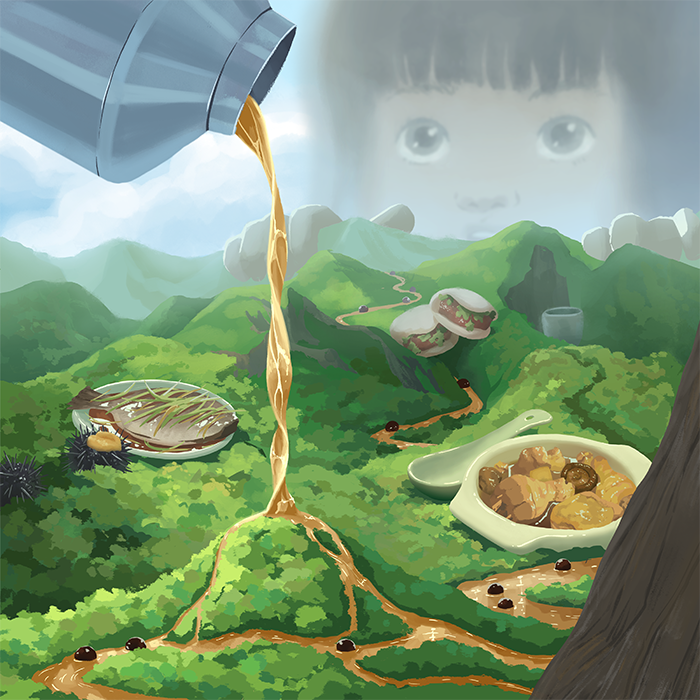
The First Prize winner in nonfiction, Bea Chang's essay "Requiem for a Bubble Tea", weaves a sensory tale of gastronomic delights and seeks to get at the root of the nostalgic impulse that drives us to remembered tastes. What strikes me most about this essay is how food is intrinsically linked to culture, and how with time and the passing of generations, culture is altered and inevitably pieces are lost. This piece captures perfectly the longing for a particular taste and how the emotions it stirs bring us closer to who we are. The
genius of it, however, captures how imperfectly we are ever able to duplicate a taste, or emotion, and how our relationships to our families and ourselves are always changing and impermanent, even in memory.
Nonfiction Honorable Mentions dwell on how to process losing the life you wanted and making the best of the one you have. A new mother grieves the death of her own mother while recounting the lessons she taught her and how to pass them on. A restaurant manager bonds with an unhoused man over not what sets them apart but what brings them together—Shakespeare, of all things. In another essay, a woman tries to reconcile the lasting effect of a magnetic friend while mourning the end of the relationship. Other essays discuss the unbearable day-to-day suffering that comes with caring for a young child with cancer, and the philosophy one prisoner fashions for himself to survive incarceration. Two other essays bring us into the world of losing a dream long deferred.
In one, a couple's dream ends before it's realized when they must abandon their dream home in Costa Rica for cancer treatment in the US. In the second, a woman's quest for answers turns into providing them for someone else, whose suffering has outmatched her own.
Nonfiction Honorable Mentions went to:
Aria Dominguez, "Architectural Plans"—What do we do when the dream for our life is rerouted? In this essay, a couple is forced to abandon building the dream home they've always wanted in the husband's home country of Costa Rica, when he must return to America for cancer treatment.
Martha Grace Duncan, "So Have I Been a Good Stepmother?"—This essay covers the difficult terrain of a woman searching for her stepmother three decades later to understand her father's death by suicide. She recounts the abject poverty, implied drug abuse, and poor physical and mental health of the woman who views herself as her stepmother during the single visit she makes. Along the way, she discovers that although she was the one seeking answers, she is inexplicably in the position to offer them.
Katherine Dykstra, "All Girls, But One"—We have all had that one friend who is so bewitching, and left such a deep imprint, we've never been the same. This unique essay chronicles the origins and pull of such a powerful and life-altering friendship and meditates on how the spell cast on us by others changes our story, too.
Doug Emory, "Perfect"—This work of nonfiction moves with the tension and power of a train going full speed ahead. Chronicling the excruciating experiences of a father caring for a child with cancer, it reveals how the most mundane experiences are the ones that matter most.
Robin Hirsch, "Shakespeare"—This essay sets itself apart as I've never read a story about someone showing so much love and kindness and taking such good care of someone who is unhoused. While making a man breakfast and letting him use the facilities of his restaurant to clean up, they bond over Shakespeare and the well-worn truths those works share about our common humanity.
Steven R. Perez, "Process: An Excerpt"—This excerpt from an incarcerated man moved me, not only with detail about life behind bars and the attendant feelings of being locked away and withheld from society, but also in its learned philosophy that things can always be worse, and sometimes are, and that despite suffering on a daily basis we can be grateful that life keeps going no matter your circumstances.
Christy Tending, "An Ornithology of Grief"—An absolutely beautiful, stunning rumination on grief. Told through the lens of the birds whose names her mother taught her, a daughter reflects on the gifts her mother gave her and her desire to impart them to her own children.
Each of these stories and essays offers a different take on what it means to live with loss, and how to find what it takes to keep going. This is the strength of great literature, to provide glimmers of understanding, to help us make sense of both the everyday obstacles and the grand tragedies of our lives. I trust the words of these writers will help you probe the depths of your own understanding and see a little more clearly the narrative of your own life.