No images? Click here


12 January
Biden changing rules for 2022
The United States Studies Centre (USSC) and Congress both return to work this week, with the US House and Senate in session for the first time since mid-December. This past week also marked the sombre anniversary of the pivotal Capitol insurrection, where pro-Trump protesters breached the Capitol Building, and forced Congress to evacuate as they were certifying the results of the 2020 election. A bipartisan Senate report determined that seven individuals died in connection to the Capitol attack, including three police officers. The insurrection occurred shortly after the surprise election of two Democratic Senators from Georgia, giving Democrats the slimmest possible upper hand in the Senate and thereby securing control of both houses of Congress and the White House.
With polls and history indicating a Republican takeover of Congress in the November 2022 midterm elections is likely, President Biden wasted no time in travelling to Georgia to rebuild political support and set a proactive agenda. First and foremost, the president appears to no longer be prioritising Build Back Better – a top legislative priority for much of 2021. The massive legislative package all but died when Senator Manchin (D-WV) took to Fox News in December to publicly announce his opposition to the Democrat-only legislation. Voting rights legislation is the new priority, with Biden saying in Georgia this week that, “we have no option but to change the Senate rules, including getting rid of the filibuster.” Axing the Senate's filibuster would ultimately allow the Democrats to pass federal voting rights legislation that would otherwise never garner enough Republican support to reach the necessary 60-vote threshold.
This power play in Congress sets the stage for a game-changing year. To analyse what’s ahead in 2022, we hope you can join us on 20 January for our first webinar of the year: What to expect in politics and policy in 2022.

NEWS WRAP
New year, same challenges
- Omicron and on and on | In the wake of the Omicron variant, unclear COVID case counts, and the looming record for the highest rate of hospitalisation since the pandemic began, the Biden administration faces a major test in its pandemic management. The Centers for Disease Control and Prevention changed guidelines on isolation for infectious people as staffing shortages across hospitals and other critical industries persist. Meanwhile, the US Supreme Court has yet to issue a ruling on
the administration’s vaccine mandate for federal government workers. READ MORE HERE
- All eyes on Georgia | President Biden brought his voting rights campaign to Georgia today, delivering a major speech in Atlanta where he and Vice President Harris criticised the Senate filibuster and ‘anti-voter laws’. And in the state on Friday, the three men convicted of murdering Ahmaud Arbery in May 2020 received life sentences. Even before their conviction, the death of Arbery prompted the introduction of Georgia’s first-ever hate crimes act last year. READ MORE HERE
- BBB on the back burner | For Democrats in the new year, it seems a major flank of Build Back Better is on the back burner, with US$555 billion worth of policies to cut emissions and boost clean energy stalled in the Senate. As pressure mounts for the administration to find new ways to meet its ambitious COP 26 climate emissions targets, recent reports demonstrate US greenhouse emissions increased 6.2 per cent from 2020 levels during 2021. READ MORE HERE
- US now leads world in LNG exports | Overtaking previous front runners Qatar and Australia, the United States became the world’s largest exporter of liquefied natural gas (LNG) in December 2021 accounting for around 22 per cent of the world’s LNG supply. With several major US developers recently signing long-term deals, many of which with Chinese buyers, the United States’ global lead is only expected to grow and remain until at least 2025. READ MORE HERE

I am, as you know, a Black person, descended of people who were given the vote by the 15th Amendment to the United States Constitution. The 15th amendment was not a bipartisan vote, it was a single party vote that gave Black people the right to vote. Manchin and others need to stop saying that because that gives me great pain for somebody to imply that the 15th Amendment of the United States Constitution is not legitimate because it did not have bipartisan buy-in.
Remarks by Rep. Jim Clyburn (D-SC) | 9 January 2022

WEBINAR | 20 January 2022
What to expect in US politics and policy in 2022
On the one-year anniversary of President Biden’s inauguration, experts from the United States Studies Centre will give their take on what to expect in US politics and policy in 2022. President Biden’s supporters posit that, in passing the American Rescue Plan Act and the Infrastructure Investment and Jobs Act, he has already accomplished more first-year legislative wins than any president in generations. Yet amid questions of competence following the chaotic Afghanistan withdrawal, inflation rates the highest in decades, the prospect of the most significant changes in abortion law in nearly half a century, and ever-worsening poll numbers potentially foreshadowing a GOP takeover in the midterms, President Biden and the Democrats are undeniably on the defensive.
What are the issues likely to dominate US politics and the midterm elections in 2022? What comes of the Biden administration’s policy agenda if Republicans take back control of Congress? What issues should Australians keep an eye on?
To discuss these issues, please join us for a webinar discussion with USSC politics experts, Senior Lecturer in US Politics and Foreign Policy Dr Gorana Grgic, Non-Resident Senior Fellow Bruce Wolpe and Senior Research Fellow Jared Mondschein in conversation with CEO Professor Simon Jackman.
WHEN:
SYDNEY | Thursday, 20 January 2022 | 9:00-10:00am AEDT
WASHINGTON DC | Wednesday, 19 January 2022 | 5:00-6:00pm EST
COST:
Free but registration is essential.
You can also subscribe to have event invitations and reminders sent straight to your inbox, so you never have to miss an event!

ANALYSIS
Why politicians like Dole and Reid matter
Stephen Loosley, AM
Non-Resident Senior Fellow, United States Studies Centre
There should be a platinum law for every parliamentarian who wishes to make an indelible mark for the better in public office. It is made up of three interlocking strands: never forget who elected you; never ignore their interests; and continue to be shaped by their values. Two superb examples come to mind.
Last month should be remembered not only for the scourge of the Omicron variant of Covid-19 but for the extraordinary loss to Western parliamentary culture registered in the deaths of two remarkable US senators: Bob Dole and Harry Reid. Both left an enduring impact not only on the workings of the most powerful legislative body in the world, the US Senate, but on democratic culture everywhere.
Republican Dole ran unsuccessfully for executive office more than once. Most significantly, he was president Gerald Ford’s running mate in 1976 when the Republican ticket was defeated by the Democratic pairing of Georgia Governor Jimmy Carter and Senator Walter Mondale of Minnesota. The vice-presidential debate that year was something to savour, but more of that later.
Reid, like Dole, was also a fighter. Dole was a war hero, having suffered terrible injuries that disfigured him for life in the final weeks of the Italian campaign in April 1945. He was left for dead on the battlefield. Too young for war, Reid was a boxer and what he learned in the ring served him well in politics.
As with his compatriot from Kansas, Reid found his niche in the US Senate, where as majority leader from 2007 to 2015 he was arguably the most influential Democrat since Texan senator Lyndon B. Johnson, also incidentally born without anything approaching a silver spoon and reared in the Texas Hill Country.
Indeed, Obama said he would never have been able to reach the presidency or achieve what he did, including Obamacare, without Reid’s skill and commitment. Biden observed that he valued Dole’s counsel and always looked to him for good humour to defuse difficult situations.
These are excerpts from an article published by The Australian.

BY THE NUMBERS
Record US and Australian COVID-19 hospitalisations
Despite the Omicron variant appearing milder than previous strains, both the United States and Australia are reporting record high hospitalisation rates due to COVID-19.
Currently, 150 per million Australians are hospitalised with COVID-19, more than double the peak of the Delta wave, where 60 Australians per million were hospitalised.
In the last two days, the United States recorded 414 hospitalisations per million people, already a higher amount than the peak of hospitalisations last US winter where 404 Americans per million were hospitalised with COVID-19.
Read more By the numbers analysis here
VIDEO
A conversation with The New Yorker's Evan Osnos, author of Wildland: The making of America's fury
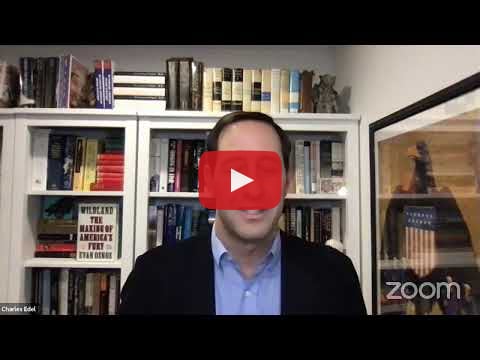
Did you miss our final webinar of 2021? Evan Osnos, National Book Award and Pulitzer prize-winning author of Wildland: The Making of America’s Fury joined USSC Non-Resident Senior Fellow Dr Charles Edel to discuss his award-winning book and the moments that led to US political dissolution and division.
Catch more analysis on the United States on the USSC YouTube channel.


Manage your email preferences | Forward this email to a friend
United States Studies Centre
Institute Building H03
University of Sydney NSW 2006


