|
Top headlines
Lead story
In May 1945, Allied commanders gathered journalists from around the world in Reims, France, to witness the surrender of Nazi Germany.
In exchange for granting them access, the top brass had one request: The reporters could not publish the news until given the green light. That meant they had to sit on the scoop for more than 24 hours – an almost unheard-of amount of time in a fast-paced, competitive news cycle.
Would they hold the line? Read Boston University journalism professor Chris Daly’s story, which we picked from the archive on this Memorial Day, about the press’s coverage of V-E Day to find out.
[Sign up here for our Understanding AI series – four emails delivered over the course of a week.]
|
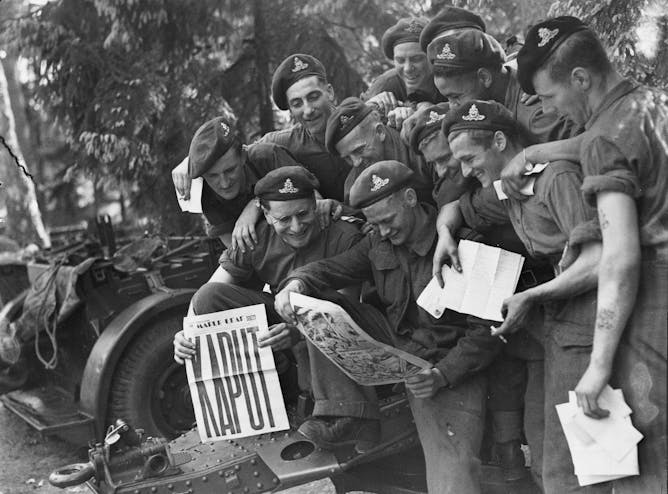
Canadian Artillery gunners read the Victory issue of the Maple Leaf newspaper in Germany after Germany surrenders.
REUTERS/Lieut. Donald I. Grant /Canada Department of National Defence/Library and Archives Canada/PA-150931
Christopher B. Daly, Boston University
As we commemorate Memorial Day, the drama behind the headlines announcing Germany’s surrender in World War II.
|
Economy + Business
|
-
Bryan Keogh, The Conversation; Matt Williams, The Conversation
The deal would raise the ceiling for two years, cap some federal spending and impose new work requirements on certain federal benefits. It still needs the blessing of Congress.
|
|
Ethics + Religion
|
-
Ralph H. Craig III, Stanford University
Turner was introduced to Nichiren Buddhism in 1973, and its teachings provided inspiration for some of the final projects of her career.
-
Katrina Stack, University of Tennessee; Derek H. Alderman, University of Tennessee
For some military members, a hillside in California embodies the sacrifices of serving.
|
|
Politics + Society
|
-
-
Robert Gudmestad, Colorado State University
There was one central reason the Civil War happened.
-
Raymond Scheppach, University of Virginia
How will the House vote on the deal negotiated by the White House and GOP leaders? If they reject it, there are political as well as huge economic risks to debt standoffs in Congress.
-
Richard Gardiner, Columbus State University
Memorial Day was born out of generous gestures after the Civil War: Southerners decorated graves of Confederate soldiers as well as those of former Union enemies.
|
|
Science + Technology
|
-
Anirban Basu, University of Washington
Biased algorithms in health care can lead to inaccurate diagnoses and delayed treatment. Deciding which variables to include to achieve fair health outcomes depends on how you approach fairness.
|
|
Education
|
-
Joshua Childs, The University of Texas at Austin
About 10 million US children are chronically absent from school.
|
|