|
Truth-telling is an act of sharing between Indigenous and non-Indigenous peoples, in an effort to acknowledge a difficult national history that has disproportionately affected First Nations peoples. As researchers Lynley Wallis, Heather Burke and Troy Meston write, “the Native Mounted Police is one such difficult story in Queensland’s truth-telling process.”
The researchers scoured more than 20,000 documents and artefacts over seven years to shed light on the 450 officers and more than 1,000 Aboriginal troopers who made up the Native Mounted Police. They found the Native Mounted Police operated in Queensland for 80 years and each “troop” had between six and 15 Aboriginal troopers under the command of white officers.
They researched at length what made Aboriginal boys and men enlist in a force whose job was to hunt down and kill other Aboriginal people. The reasons were many and varied, but as they write about in their research, many were coerced, threatened with harm and prison, or left with no other option.
As the authors state, “Australia’s colonial history has been built on policies designed to secure and maintain possession of Indigenous lands. Historically, colonial powers employed forces like the Native Mounted Police to enact widespread violence on the Indigenous people who stood in the way of this.”
And as they write today, truth-telling in this country will mean coming to terms with this violent history.
|

|
Carissa Lee
First Nations and Public Policy Editor
|
|

Lynley Wallis, Griffith University; Heather Burke, Flinders University; Troy Meston, Griffith University
Frontier violence was widespread across colonial Queensland and has real life implications for contemporary Australia.
|

Taren Sanders, Australian Catholic University; Chris Lonsdale, Australian Catholic University; Michael Noetel, The University of Queensland; Philip D Parker, Australian Catholic University
A major study of screen use found it’s not the screen itself that really matters but what’s on it and the way kids use it.
|

David Tuffley, Griffith University
Port operator DP World handles roughly 40% of Australia’s sea freight. Over the weekend its ports were disrupted by what appears to be a malicious, targeted cyberattack.
|

Amy Clair, University of Essex; Emma Baker, University of Adelaide; Meena Kumari, University of Essex
People age differently depending on the lives they lead. DNA testing shows every year of living in a privately rented home add 2.4 weeks of ageing compared to those who own their home.
|
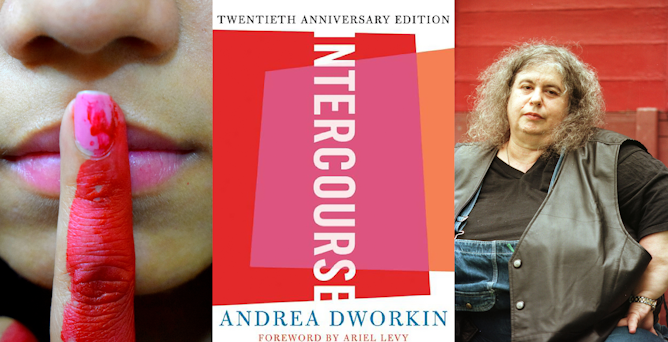
Camilla Nelson, University of Notre Dame Australia
In Intercourse, Andrea Dworkin set out to expose the power dynamics underpinning sexual relationships. Her book was pilloried in the 1980s, but many of her ideas no longer look so radical.
|

Sacha Pidot, The Peter Doherty Institute for Infection and Immunity
Scientists are racing to discover new antibiotics that can defeat these drug-resistant superbugs. So how is the newly developed antibiotic clovibactin different?
|

Amy Dawel, Australian National University; Ben Albert Steward, Australian National University; Clare Sutherland, University of Aberdeen; Eva Krumhuber, UCL; Zachary Witkower, University of Amsterdam
AI-generated faces are now readily available, and have been used in identity fraud, catfishing and cyber warfare.
|
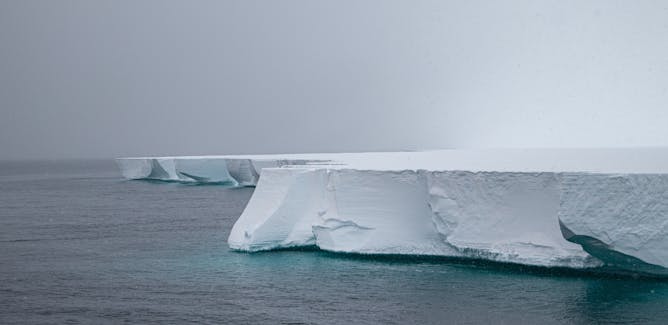
Richard Levy, GNS Science; Dan Lowry, GNS Science; Denise Kulhanek, University of Kiel; Gavin Dunbar, Te Herenga Waka — Victoria University of Wellington; Huw Joseph Horgan, Swiss Federal Institute of Technology Zurich; Molly Patterson, Binghamton University, State University of New York; Nick Golledge, Te Herenga Waka — Victoria University of Wellington; Tina van de Flierdt, Imperial College London
Seafloor sediments from beneath the Ross Ice Shelf represent an archive of warmer periods in Earth’s past. An ambitious international project aims to uncover what we can learn about our hotter future.
|

David Lindenmayer, Australian National University; Chris Bousfield, University of Cambridge; David Edwards, University of Cambridge
Satellite data shows wildfires are destroying large areas of timber-producing forests around the world. These fires are becoming more destructive with each passing year.
|

Matilda Hatcher, Australian National University
Is the cure to male loneliness sailing the high seas with your bros?
|
Politics + Society
|
-
Elizabeth Handsley, Western Sydney University; Fae Heaselgrave, University of South Australia
We’re all familiar with a green ‘G’ or a red ‘MA’ on a movie poster, but those ratings don’t have any basis in what we know about child development. They’d be much more useful for parents if they did.
-
Denghua Zhang, Australian National University; Bernard Yegiora, Divine Word University
Three new surveys paint a mixed picture of local feelings about China. The participants did not simply ‘love China’ or ‘hate China’, but had more complicated perceptions of the country.
-
Adrian Beaumont, The University of Melbourne
Labor still leads on two-party preferred, but is feeling the strain as cost of living pressures take hold.
|
|
Health + Medicine
|
-
Sapha Shibeeb, RMIT University
For the majority of patients, blood collections are not a problem, just a minor inconvenience. Others may feel uneasy and anxious about the process.
|
|
Environment + Energy
|
-
Avril Horne, The University of Melbourne; Andrew John, The University of Melbourne
Buying back water from irrigators across the Murray-Darling Basin will not be enough to restore river health because we have big problems getting this ‘environmental water’ to where it’s needed most.
-
Shannon Davis, Lincoln University, New Zealand
New Zealand cities grow mostly through building houses on undeveloped land. But this removes fertile soil and undermines the food production and other ecological functions city dwellers depend on.
|
|
Books + Ideas
|
-
Craig Billingham, UNSW Sydney
Pi O is known for his wit and irreverence. His anarchism, reflexive anti-Americanism and anti-capitalism are all part of the deal.
|
|
Business + Economy
|
-
Flavio Macau, Edith Cowan University; Paul Haskell-Dowland, Edith Cowan University
A cyberattack on one of Australia’s biggest port operators has highlighted the potential vulnerability of the global economy.
|
|
| |
|
|
|
The Conversation AU
Melbourne VIC, Australia
•
Full Time
|

|
|
The Conversation AU
Melbourne VIC, Australia
•
Full Time
|

|
|
|
|
| |
| |

|
| |
| |
| |
Featured Events, Courses & Podcasts
|
View all
|
|
1 January 2023 - 7 October 2026
•
|

|
21 - 22 November 2023
•
Melbourne
|

|
2 December 2023
•
The University of Sydney
|

|
7 December 2023
•
Randwick
|

|
|
|
|
| |
| |
| |
| |
| |
|
|


