

Join us at DiCE Annual Event!
Join us for an inspiring day at the Philips High Tech Campus in Eindhoven, Netherlands where we’ll share the latest progress from the DiCE project - from our brand new Circular Design Guide through early results from smart collection pilots to the value chain mapping of our endocutter case study. We’ll also dive into circular business models for healthcare devices and look at key policies that can help (or hinder) the shift to more sustainable systems.
Along the way, you’ll have a chance to meet and connect with peers and exchange ideas in our policy workshop. Those who act fast, may also join an exclusive visit to MIREC’s recycling plant to see circularity in action. (Please note that the visit is limited to very small group due to safety regulations.)
Come curious, leave inspired and help us shape the future together!
DiCE Consultation: Can Circular Models Work Across Different Healthcare Systems?
We invite you to share your insights in our latest DiCE project survey (Digital Health in the Circular Economy). This survey explores how circular models - using examples like smart packaging (digital display labels) and surgical devices (such as surgical staplers) - can be effectively implemented and scaled across different countries and healthcare contexts.
Your input is especially valuable as we assess the potential for replicating these business models in Belgium, Spain, Denmark, and Slovenia, taking into account factors such as healthcare systems, regulatory environments, cultural norms, and demographic differences.
The survey will take approximately 15 minutes to complete. Your insights will directly support the development of circular economy strategies, such as reuse initiatives, and help us identify both opportunities and barriers to the broader adoption of reused smart packaging in healthcare and beyond.
Thank you in advance for your valuable contribution!
Crash Course on Regulation and Policy with INCREACE
Join the INCREACE Project and DiCE for a crash course on regulation and policy, to gain insights into current policy landscapes, barriers, and opportunities. Sonia Valdivia from WRF will represent DiCE and share our work on policy barriers and recommendations for improving the circularity of medical devices.
INCREACE aims at increasing the uptake of recycled plastics in various products through innovative and interdisciplinary solutions. This goes along the plastics recycling value chain embedded in a systemic framework with a focus on Electrical and Electronic Equipment (EEE). By using (in principle) recycled plastics from Electrical and Electronic Waste (WEEE), the INCREACE project will tackle areas where the use of recycled plastics is marginal today.
🕓 16:00-17:00 CET, 25 September 2025
🔗 Online
See below other sessions in the Crash Course series organised by INCREACE:

DiCE’s Take on the EU Medical Devices Evaluation
The European Commission launched a public consultation and call for evidence as part of its targeted evaluation of the EU’s legislation on medical devices and in vitro diagnostic medical devices in 2024. The consultation was aimed to gather feedback from stakeholders on the effectiveness of the current regulations and identify potential areas for improvement.
The regulations governing medical devices and in vitro diagnostics are designed to ensure that only safe and effective products are available in the market, while fostering innovation and competitiveness within the industry.
The evaluation focused on several key aspects, including the effectiveness of the rules, their associated costs, and the administrative burden they impose. It also assessed the benefits for patients and users, as well as the impact on device availability, including “orphan devices,” and the development of innovative technologies.
Seizing the opportunity to shed light on the importance of circular practices for medical devices, DiCE experts submitted three key comments as part of the consultation:
- Insufficient Evidence
- Lack of Harmonisation
- Unclear Reprocessing Criteria

Exploring Sustainable Value Chains for ECG Lead Sets
Earlier this year, our consortium peers from Ghent University and MIREC joined an insightful workshop on value chains, followed by an exciting tour of MIREC’s recycling plant. Rebecca Baaijens, Project Manager of European Subsidy Projects at MIREC, guided us through the facilities in the afternoon after an engaging morning session.
During the workshop in the morning, we focused on the value chains of ECG lead sets for both single-use and reusable cases. ECG lead sets are electrode cable systems used to transmit signals from patient electrodes to various electrocardiograph monitors for both diagnostic and monitoring purposes. In the industry, these kinds of consumables are designed for single-use and multi-use, whereas for multi-use, different reprocessing scenarios are available.
Sustainable Technology Design: HCI Principles That Matter
Brought to you by Hüseyin H. Keke and Christian Meske from Ruhr-Universität Bochumniversität Bochum
Every day, we interact with countless digital devices – from smartphones and laptops to smart home systems. But have you ever wondered what happens to these devices when we’re done with them? As our technology consumption increases, so does electronic waste. This growing concern has sparked an important movement in the world of technology design.
Human-Computer Interaction (HCI) is the field that studies how people use technology and how to design technology that meets people’s needs. Over the years, researchers have developed frameworks for incorporating sustainability into technology design, recognising that environmental concerns shouldn’t be an afterthought but should guide the entire design process from the beginning.
Challenging Healthcare’s Digital Transformation: Is Sustainability Compromised?
Brought to you by Tamara Hoveling from TU Delft
In today’s digital age, healthcare is swiftly adopting digital solutions, from electronic health records to telemedicine consultations. Even everyday medical devices like thermometers and blood pressure monitors have gone digital. As we push forward, let’s take a moment to reflect: are we balancing sustainability and practicality with our drive for innovation? Perhaps not.
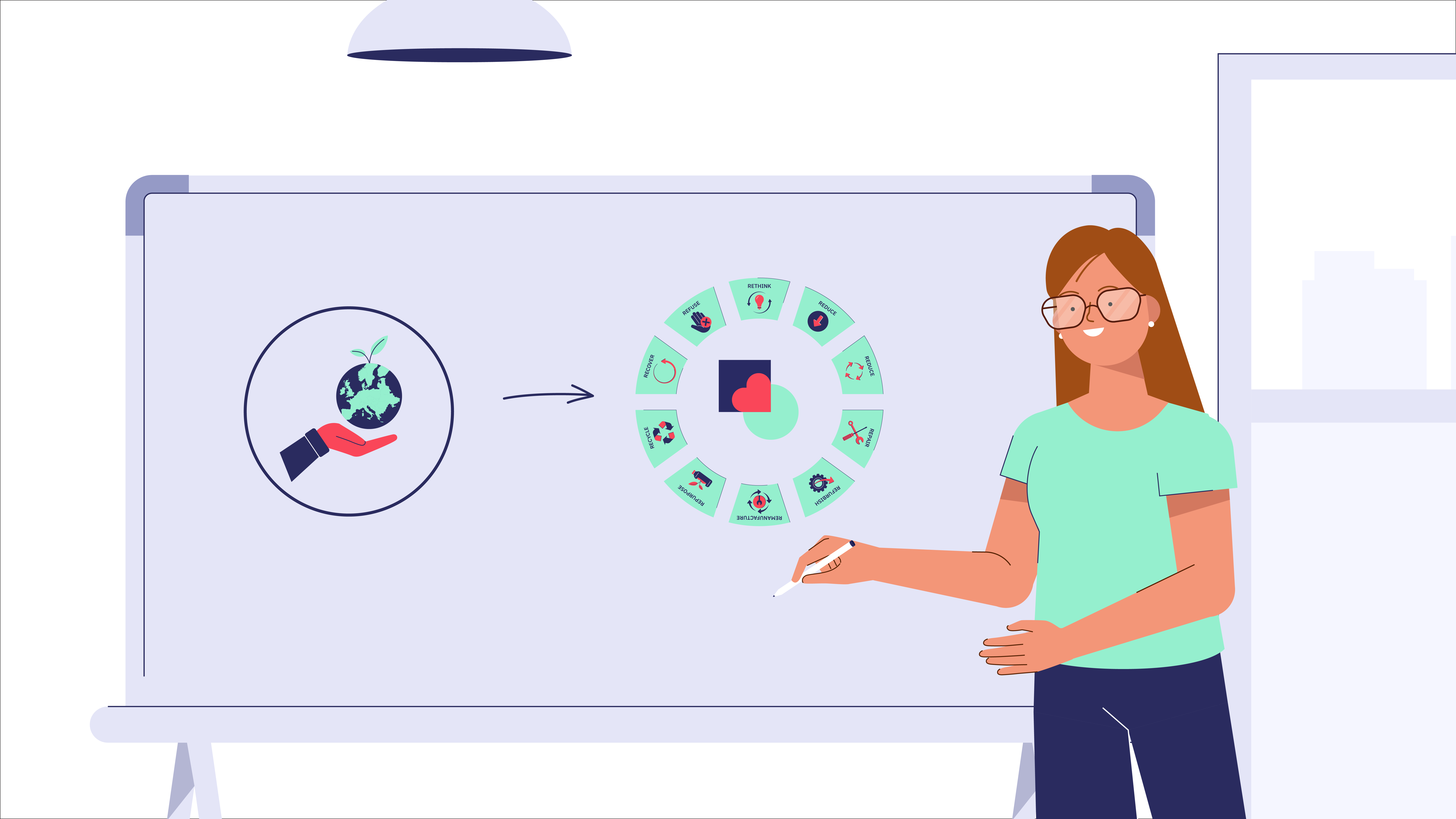
Refuse is the prioritised sustainability strategy presented in the 10R framework. Yet, we often find ourselves trying to reuse, remanufacture or recycle powered medical devices that perhaps did not even need contain any electronics in the first place.
How does automation bring huge opportunities for healthcare?
Why does digitalisation often cause more impacts than it saves?
Circular Business Models: More than Recycling
Brought to you by Andreas Wieland, Christiane Lehrer, Attila Márton from Copenhagen Business School
We have made the observation that the circular economy is often misunderstood as simply a sophisticated approach to recycling. This perception limits its fantastic potential and leads organisations to underestimate the scope and scale of true circular innovation. At its core, the circular economy is not about recycling – it is about reimagining entire business models.
Take-make-waste model
Traditionally, our economic system has been linear: resources are extracted, parts, modules, and goods are manufactured, consumers buy and use these goods, and then they are discarded. This take-make-dispose model has proven unsustainable in an era defined by climate and biodiversity crises and planetary boundaries. The transition to circularity offers a promising alternative by radically redefining how products are created, used, and reused.
Recycling
Recycling, while important, can be seen as the weakest and most value-destroying loop in a truly circular model. It implies breaking down products to their raw materials – a process that typically involves significant losses of energy and resources, thereby reducing overall value. In contrast, truly circular business models emphasize preserving value through product longevity, reuse, refurbishment, and remanufacturing.
Sharing is caring
Do you know someone in your local network who would be interested in the outcomes of DiCE? Click here to download our leaflet in Slovenian, Flemish or Spanish. English speakers are no exception either, find your copy here! All interested parties are also invited to register to the DiCE network!
Follow us on social media:


This project is funded by the European Union under the Horizon Europe Research and Innovation Programme. The contents of this newsletter only reflect the views of the project.
