|
|
|
|
This past week, we published three stories that looked at mass shootings in America. And I realized, as I put together this newsletter, that each of those stories represents a different path to publication in The Conversation.
The first one, by Penn State scholar Lacey Wallace, came to us in response to an “urgent media request” we sent out to our member schools after the Boulder shootings, asking if they had faculty who could contribute their scholarship on the subject of mass shootings. Penn State’s communications staffer Heather Robbins told us Wallace was interested; editor Jeff Inglis worked with Wallace to refine the story idea; and we published “Mass shootings are rare – firearm suicides are much more common, and kill more Americans” six days later.
The next one required some digging. As happens after every mass shooting, there were many calls for Congress to do something. Pass background checks. Ban assault weapons. But I knew from previous work that Congress was loath to pass such laws. Had anyone studied this phenomenon? I went deep into the Google rabbit hole, and found that a scholarly paper had indeed been written on exactly this subject. One of the paper’s authors, Christopher Poliquin at UCLA, was up for distilling that research into a story for us. His story revealed some surprising information, which the headline hints at: “Gun control fails quickly in Congress after each mass shooting,
but states often act – including to loosen gun laws.”
Finally, there’s the story by Zach Lang and Jennifer Selin which came to us via an email from Selin, who has done stories for us before. Would we be interested, she wrote, in an article about their “original data that examines mass shootings, various types of gun control legislation and the characteristics of mass shooters 1980-2020?” We were, and we got a story, “In gun debate, both sides have evidence to back them up,” that looks past the partisan billingsgate and helps readers evaluate proposals from both sides of the aisle.
|
Naomi Schalit
Senior Editor, Politics + Society
|

|
|
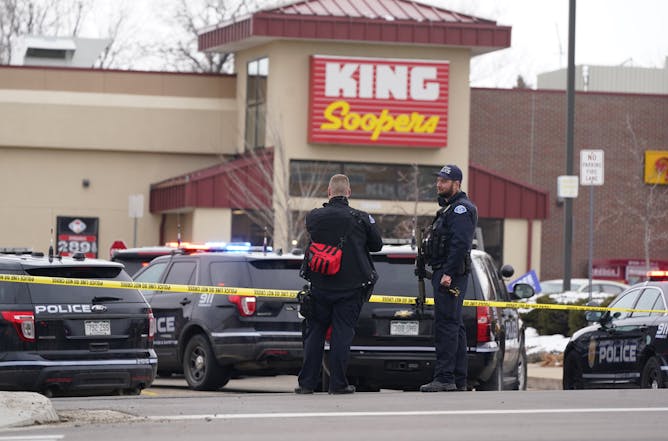
Police stand outside the King Soopers in Boulder, Colorado, where a gunman killed 10 people on March 22.
AP Photo/David Zalubowski
Lacey Wallace, Penn State
Gun violence as a whole is much more common, and much more deadly, than mass shootings are.
|
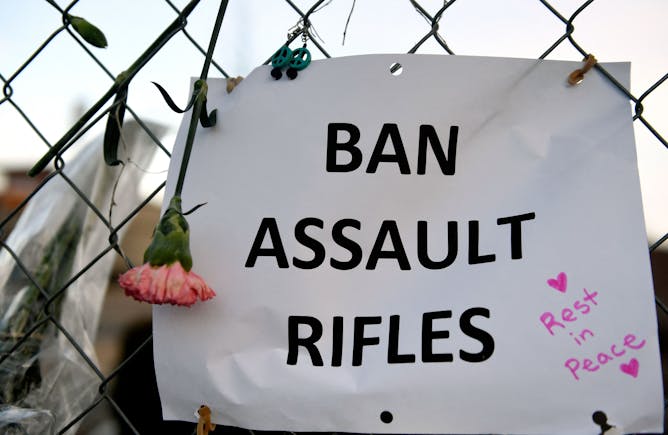
After mass shootings, there are more calls for gun control. Here’s one in Boulder, Colo., where 10 people died in a shooting.
Jason Connolly / AFP/Getty Images
Christopher Poliquin, University of California, Los Angeles
After mass shootings, politicians in Washington have failed to pass new gun control legislation, despite public pressure. But laws are being passed at the state level, largely to loosen restrictions.
|
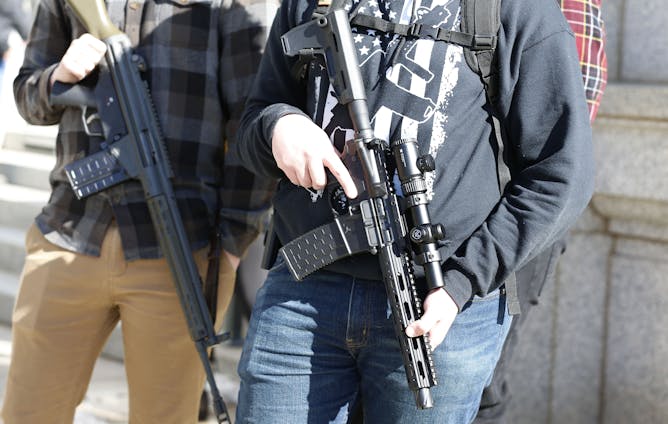
People who want to restrict guns have a point, but so do people who say those laws make little difference in mass shootings.
George Frey/AFP via Getty Images
Zach Lang, University of Missouri-Columbia; Jennifer Selin, University of Missouri-Columbia
Stricter gun control laws may make mass shootings slightly less common, but other policies may work better to prevent mass shooting deaths.
|
|
|
-
Ediberto Román, Florida International University
Unaccompanied minors pose a humanitarian challenge for Biden, as they did for Trump and Obama. There are no quick fixes to child migration and many vexing complications, says an immigration scholar.
-
Luis Gómez Romero, University of Wollongong
Mexico would not fully legalize cannabis; its new regulation plan makes recreational use legal. However modest, that would be a symbolic milestone for a country immersed in a long, deadly drug war.
-
Kevin M. Lerner, Marist College
Press-bashing was a feature of the years Trump was president. But a new, more constructive kind of press criticism has also emerged that aims to improve journalism, not delegitimize it.
|
|
| |
| |
| |
| |
| |
| |
|
|
|
|
|
|
|
