|
Hello, this is an exclusive look at Ukraine Recap, a new weekly newsletter from The Conversation, for our daily newsletter subscribers. As The Conversation's International Affairs Editor, I am able to call on a large number of academic experts with a deep knowledge of every aspect of this situation, whether it’s military, political, social or economic. And every Thursday, I will write a comprehensive summary of their analysis so that you can keep on top of this crisis. Click here to subscribe to Ukraine Recap and get future emails.
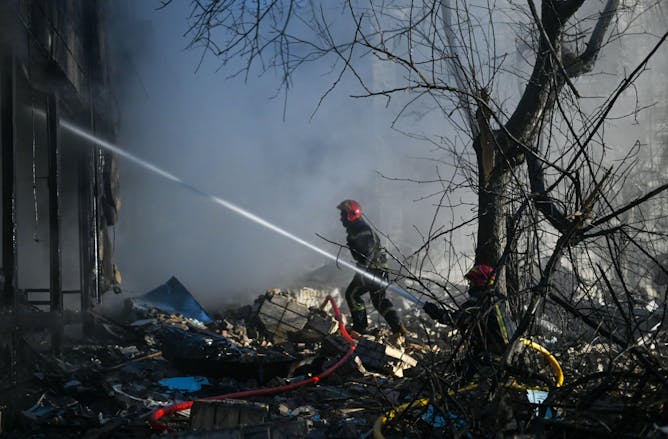
It’s just over a week since the Russian president, Vladimir Putin, sent his war machine into Ukraine with the aim of toppling the government of Volodymyr Zelensky, “denazifying and demilitarising” the country and sending the bloodiest of messages to Nato about its expansion into eastern Europe. Things have since moved with dizzying speed.
Truth is said to be the first casualty of war, but there’s no reason for the demise of knowledge and expertise. In an assessment of Ukraine’s defensive capabilities, Frank Ledwidge, an expert on military strategy at the University of Portsmouth, predicted on day two of the invasion that while the Russians enjoyed superior firepower the Ukrainian people would fight passionately for their homeland. What Putin was expecting would be a relatively easy “military operation”, wrote Ledwidge, could turn out to be a protracted and bloody affair. And so it has proved.
Now, in a follow-up article analysing how the war is going for Russia, Ledwidge asserts that it is likely that the fact that Putin had imagined a swift conquest had dictated his overall strategy, which has been found wanting. This is becoming a bitter struggle and the casualty list is growing.
How did we get here?
This crisis has been brewing for some months as Russia moved 190,000 men and material to its border with Ukraine and, more recently, into Belarus. All the while Putin was beating the drum of Slav nationalism, insisting that Russia and Ukraine were one country with inseparable origins. This is a curious reading of the history books, writes Olivia Durand of Oxford University.
Putin has also expressed his concern the Nato has reneged on a pledge after the Soviet Union collapsed in 1991 that it would not expand into the former Soviet republics. Whether there was indeed a formal pledge along these lines is doubtful, writes Gavin Hall of the University of Strathclyde.
But what is not in doubt, writes Aldo Zammit Borda of City, University of London, is that Russia, Ukraine, the UK and US sat down and agreed that Ukraine’s sovereignty and territorial integrity would be respected. In return, Ukraine gave up its nuclear arsenal, at the time the third-largest in the world.
And now Putin has raised the grim spectre of nuclear conflict once again, announcing that he had put his country’s nuclear deterrent on high alert. A hollow threat? Russia’s military playbook has always relegated the nuclear option to the status of a last resort, write Mark Webber and Nicolò Fasola of Birmingham University. But one can’t guarantee that Putin will remain a rational actor in all this.
So what can you do?
We’re going to be hearing a lot more about more than a million people who have fled their homes in Ukraine to seek refuge in other European countries. It’s a major humanitarian crisis, among the worst in Europe since the end of the second world war.
The EU and its member states have displayed unprecedented levels of solidarity and cooperation in recent days, possibly a more proactive response than it has shown to the waves of refugees from the Middle East in recent years where the approach has been to prioritise ideas about security concerns over the wellbeing of displaced people. This shows what can be achieved when the political will is there, write Gillian McFadyen and Arddun Hedydd Arwyn of Aberystwyth University.
Many of us will be prompted to give to charities to help these refugees in their hour of need. But before you do, please heed this advice from experts Sarah Schiffling of Liverpool John Moores University and Wojciech Piotrowicz of Hanken School of Economics in Finland: it’s always better to give money than goods like food and old clothes, which are all too often more of a hindrance than a help.
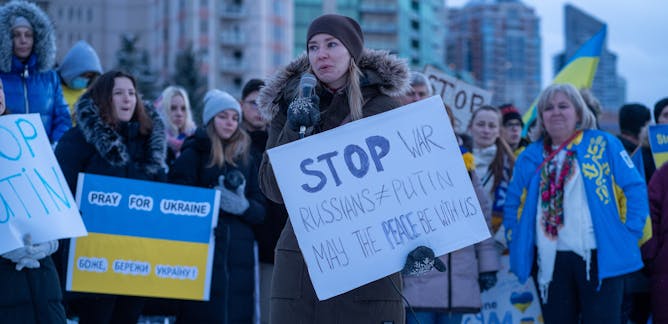
And finally, if you want to express your concern about the crisis in Ukraine, Louise Thompson of the University of Manchester has some advice about how to write to your MP and what to expect if you do.
Save the date
I’ll be hosting a webinar on the war in Ukraine on Monday March 14, with four outstanding scholars of politics, economics and migration from UK and US universities. Do let me know if you have any questions that you want our expert panel to address. I hope to see you there.
Subscribe to
Ukraine Recap
|