|
Top headlines
Lead story
The loss of the Titan submersible and the five people aboard it is a stark reminder that bringing people to the deep ocean is a dangerous undertaking. The pressure at the site of the wreck of the Titanic – the Titan’s destination – is about 380 times greater than the pressure at sea level.
Yet in order to better understand climate change, scientists need to collect data from the world’s oceans, including its deep waters. Purdue University mechanical engineer Nina Mahmoudian explains how advances in marine engineering, sensor technology and machine-learning algorithms are making it possible for researchers to meet the growing demand for this data without getting in harm’s way.
[Science from the scientists themselves. Sign up here to our weekly science email newsletter.]
|

|
Eric Smalley
Science + Technology Editor
|
|
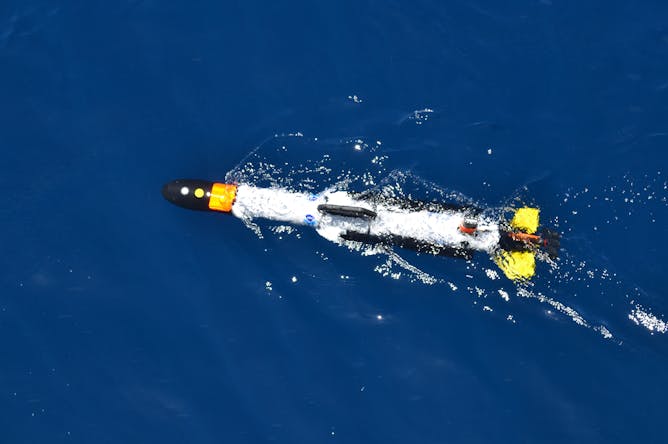
Researchers are increasingly using small, autonomous underwater robots to collect data in the world’s oceans.
NOAA Teacher at Sea Program,NOAA Ship PISCES
Nina Mahmoudian, Purdue University
Dramatic improvements in computing, sensors and submersible engineering are making it possible for researchers to ramp up data collection from the oceans while also keeping people out of harm’s way.
|
Environment + Energy
|
-
Robert Glennon, University of Arizona
By a narrow margin, the Supreme Court has ruled against the Navajo Nation in a case over water rights in the drought-stricken US Southwest.
-
A. Daniel Jones, Michigan State University; Hui Li, Michigan State University
PFAS can be filtered, but getting rid of the chemicals is a monumental challenge. A biochemist and soil scientist explain.
|
|
Health + Medicine
|
-
Maithreyi Gopalan, Penn State
The health coverage program’s enrollment soared during the three years after March 2020 due to temporary policies adopted at the start of the COVID-19 pandemic.
-
Anthony Jimenez, Rochester Institute of Technology
More than 11 million migrants who lack papers live in the United States, and many of them are ineligible for health coverage.
-
Brad Phillips, West Virginia University
Letting go of what could have been is a critical step in handling ambiguous loss.
|
|
Arts + Culture
|
-
A. Joseph Dial, Purdue University
America’s veneration of gun ownership is seconded only by its commitment to rendering armed Blacks as an existential danger to the civility and structure of America.
-
Ahmed Elgammal, Rutgers University
Visual artists draw from visual references, not words, as they imagine their work. So when language is in the driver’s seat of making art, it erects a barrier between the artist and the canvas.
|
|
Politics + Society
|
-
Robert Goldman, American University
Both sides in the Ukrainian war are thought to have used cluster munitions. The weapon takes a heavy toll on civilians but isn’t banned under international law.
|
|
Education
|
-
Todd Jones, Mississippi State University; Benjamin Cowan, Washington State University; Jeff Swigert, Southern Utah University
Summer is an opportunity for many families – and mothers and teenagers in particular – to catch up on much-needed sleep along with exercise and leisure activities.
|
|
Podcast 🎙️
|
-
Daniel Merino, The Conversation; Nehal El-Hadi, The Conversation
From the Arab Spring to the Belarus Awakening and the ongoing Iranian protest Women, Life, Freedom, female-centered imagery and social media are battlegrounds of resistance and oppression.
|
|
From our international editions
|
|
|
|
|
|
|
|---|
-
More of The ConversationLike this newsletter? You might be interested in our weekly and biweekly emails: Trying out new social media? Follow us: -
About The ConversationWe're a nonprofit news organization dedicated to helping academic experts share ideas with the public. We can give away our articles thanks to the help of foundations, universities and readers like you. |
|
| |
| |
| |
|
| |
| |
| |
| |
| |
| |
|
|


