|
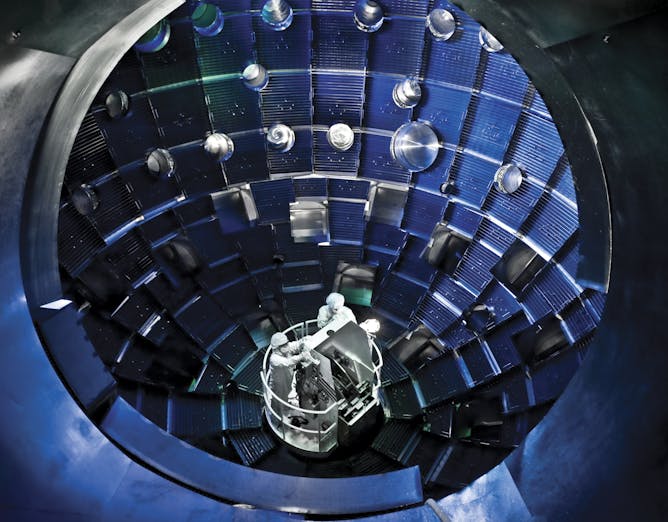
For a brief moment last week, within a large metal sphere at a lab in California, scientists recreated and controlled the power of the Sun. Using the most powerful lasers on Earth, for a few billionths of a second, a team at the Lawrence Livermore National Laboratory’s National Ignition Facility was able to fuse a few types of hydrogen together, the same reaction that produces energy on stars. What sets this experiment apart from all that have come before it is the amount of energy released was greater than the amount of energy contained in the lasers.
Carolyn Kuranz, a nuclear engineering professor at the University of Michigan who works on fusion, considers this new result to be “a truly historic scientific breakthrough.” In a phone call yesterday, she said that people in the future may look back and think of this moment as comparable to the first flight of the Wright brothers.
This experiment shows that fusion is possible, not just in theory, but in reality. While that is certainly a lot to get excited about, as Kuranz explains, there are still a number of “scientific, technological and engineering hurdles that will need to be overcome before fusion will produce electricity for your home.”
And you can read our other articles on nuclear fusion here.
|