|
|
|
|
Top headlines
Lead story
When I covered affirmative action in the 2010s, I used to ask proponents of the practice if they ever saw an end in sight for its need in American society. I was struck by how many couldn’t even bring themselves to conceive of a future in which affirmative action was no longer necessary, despite Justice Sandra Day O'Connor’s famous 2003 opinion predicting that 25 years out from that time – which would have been 2028 – the use of racial preferences would “no longer be necessary” to further the interest of diversity in higher education.
Former Secretary of Education John King, for instance, told me that he saw affirmative action as a means to diversity, which he described as an enduring goal , not “something that has a time limit on it.”
On Thursday, the U.S. Supreme Court settled the question of affirmative action’s fate in higher education, ruling that race can no longer be used in college admissions. For perspective on what that means, The Conversation reached out to three law scholars. Kimberly Robinson, of the University of Virginia, and Kristine Bowman, of Michigan State University, touch on what the decision means for America’s colleges and universities and the students they serve. And Vinay Harpalani, of the University of New Mexico, points out how the court seems to carve out a special exemption for the use of race for the nation’s soldiers and prisoners, but not for its everyday
citizenry.
Also, today is the final day of our fiscal year and of our fund drive, and we’re at 92% of our fundraising goal. Your support to close the budget gap enables us to produce more of this fact-based, insightful journalism – and to let you, and everyone, read it for free. Thank you in advance for your generosity.
|

|
Jamaal Abdul-Alim
Education Editor
|
|
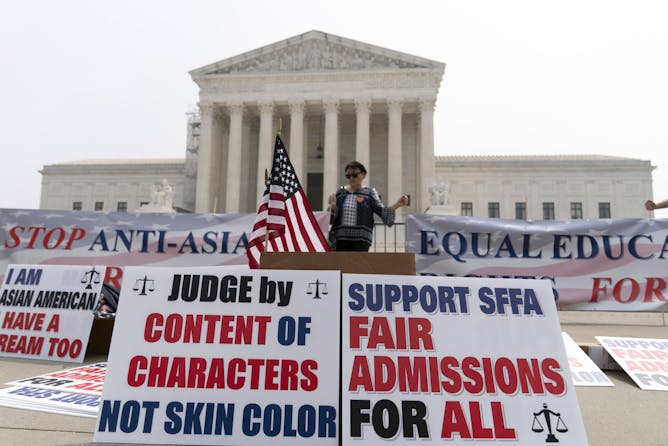
A person protests outside of the Supreme Court in Washington, D.C., on June 29, 2023.
AP Photo/Jose Luis Magana
Kristine Bowman, Michigan State University; Kimberly Robinson, University of Virginia; Vinay Harpalani, University of New Mexico
Three legal experts weigh in on what the Supreme Court’s ban on race in college admissions means for students, colleges and universities, and the nation’s future.
|
Health + Medicine
|
-
Rajiv Chowdhury, Florida International University
After recent cases in Florida and Texas, authorities are advising the public to drain standing water sources to keep mosquitoes from multiplying.
|
|
International
|
-
Joseph Torigian, American University School of International Service
China has provided Russia with economic support during the war in Ukraine. But Beijing may be concerned over recent events in Moscow.
|
|
Science + Technology
|
-
Jim Madsen, University of Wisconsin-Madison
New data from the IceCube collaboration shows neutrino emissions from within our Milky Way galaxy – but figuring out where exactly these ghost particles come from is harder than it seems.
-
Yunkang Yang, Texas A&M University; Matthew Hindman, George Washington University; Trevor Davis, Columbia University
The flood of misinformation on social media could actually be worse than many researchers have reported. The problem is that many studies analyzed only text, leaving visual misinformation uncounted.
-
Robbee Wedow, Purdue University
Biobanks collect and store large amounts of data that researchers use to conduct a wide range of studies. Making sure participants understand what they’re getting into can help build trust in science.
|
|
Politics + Society
|
-
Kenneth L. Shropshire, University of Pennsylvania
The Supreme Court’s decision to eliminate affirmative action programs sent shock waves across the US and is expected to impact racial diversity throughout society.
-
Deion Scott Hawkins, Emerson College
As violent attacks against gay people continue to increase in the US, Black transwomen face ongoing battles against discrimination in the workplace and over receiving health care.
|
|
Economy + Business
|
-
Debbie Kaminer, Baruch College, CUNY
The Supreme Court on June 29, 2023, changed the definition of ‘undue hardship’ so that employers have to accommodate more of workers’ religious requests.
|
|
|
|
Arts + Culture
|
-
Brandon D. Lundy, Kennesaw State University; Mark Patterson, Kennesaw State University; Monica Swahn, Kennesaw State University; Nancy Hoalst-Pullen, Kennesaw State University
The government and some producers are pushing to industrialize the sugar cane-based spirit to boost its popularity around the world, while small farmers fear losing their livelihoods.
-
April Nisan Ilkmen, Adler University
The US is home to more international migrants than any other country. But even though immigration is an actively debated topic, immigrants are poorly understood.
|
|
Ethics + Religion
|
-
Tanya D. Marsh, Wake Forest University
The short answer: It’s complicated – and depends, in part, where you live.
|
|
|
|
|
|
|
|
|
|---|
-
More of The ConversationLike this newsletter? You might be interested in our weekly and biweekly emails: Trying out new social media? Follow us: -
About The ConversationWe're a nonprofit news organization dedicated to helping academic experts share ideas with the public. We can give away our articles thanks to the help of foundations, universities and readers like you. |
|
| |
| |
| |
| |
|
|
|
|
|
|
|


