|
Malaria is one of the biggest killers of children under five in the world, most of them in Africa. And so when, last year, we saw that results from a phase 3 clinical trial of a new malaria vaccine developed by the University of Oxford were imminent, we wanted to talk to the people behind it for The Conversation Weekly podcast.
Last week, those results were finally released (in pre-print), showing the vaccine had an efficacy of 75%. And days later, the World Health Organization recommended its use on children, making it the second vaccine to receive such approval since 2021 and raising the possibility of eradicating the disease within decades.
We spoke to Adrian Hill, chief investigator of the group behind the new malaria vaccine, who was also involved in developing the Oxford/Astrazeneca COVID-19 vaccination. He told The Conversation Weekly all about the decades-long search for a way to prevent malaria, and why the new vaccine could be a gamechanger because of how easy it is to mass produce. You can listen to the podcast here and read excerpts of the interview with Hill too.
Another podcast you might have heard about recently is the new venture from former chancellor George Osborne and former shadow chancellor Ed Balls, who promise an inside analysis of today’s politics. But according to our reviewer, Danny Dorling, the show reveals far more about how aligned the pair were about decisions made over a decade ago – when they were supposedly political opponents – that continue to have serious ramifications today.
Plus, new research shows how female animals encourage each other to find distinctive males more attractive.
|

|
Gemma Ware
Editor and Co-Host, The Conversation Weekly Podcast
|
|
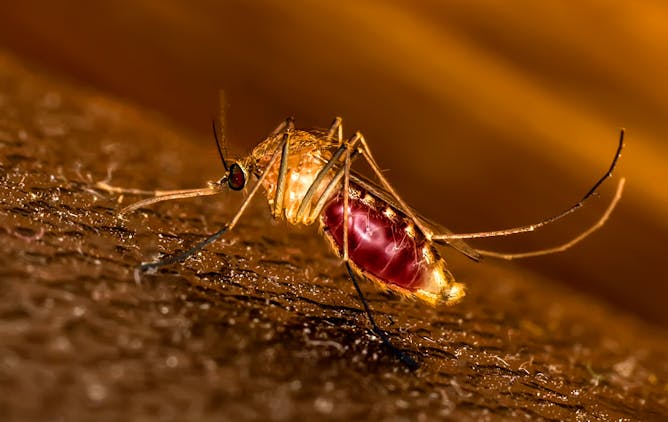
Darkdiamond67 via Shutterstock
Daniel Merino, The Conversation; Nehal El-Hadi, The Conversation
In this episode of The Conversation Weekly, we hear from the scientists behind a new malaria vaccine developed by the University of Oxford.
|
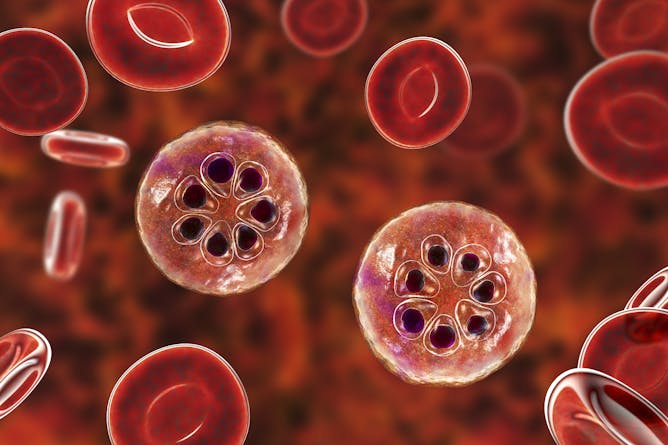
GettyImages.
Adrian Hill, University of Oxford
People have been trying to make malaria vaccines for over 100 years. With the help of the revolutionary new R21/Matrix vaccine the disease could be eradicated by 2040.
|

Osborne and Balls pictured together in 2016.
Alamy/PA/Stefan Rousseau
Danny Dorling, University of Oxford
The former chancellor and shadow chancellor have revealed how their parties collaborated on devising some of the most damaging policies of the past 20 years.
|

alexroch/Shutterstock
Louise Gentle, Nottingham Trent University
A new study modelled how a game of snog, marry, avoid, may play out in the animal kingdom.
|
Politics + Society
|
-
Michael Collyer, University of Sussex
The numbers on how many asylum seekers the UK accepts.
-
Kieran Connell, Queen's University Belfast
A historian explains what politicians like Suella Braverman and David Cameron get wrong about multiculturalism.
|
|
Arts + Culture
|
-
Glaire Anderson, The University of Edinburgh
The new game takes liberties with what medieval Baghdad looked like but reveals more about Islamic art and architecture as a result.
-
James Davison, University of Liverpool
Skeletons found with items that don’t align with their estimated sex are usually excluded from research – but that assumes a 19th century view of gender.
|
|
Business + Economy
|
-
Emmeline Taylor, City, University of London
Shoplifting in the UK has become brazen, threatening to shop staff, and seemingly without consequence.
|
|
Environment
|
-
Calum Maclaren, University College Dublin
Claims of sustainability or low-carbon flying are being challenged in court.
-
Bronwen Whitney, Northumbria University, Newcastle; Matthew Pound, Northumbria University, Newcastle
The iconic tree lived through the Little Ice Age, modern climate change, and an alarming drop in biodiversity.
|
|
Health
|
-
Viren Swami, Anglia Ruskin University
Many people have cosmetic procedures to improve how they feel about themselves – but the evidence is mixed on whether they actually do.
-
Rakhi Chand, University of Manchester
When hospital and GP staff do not reflect the population they serve, patients’ health suffers.
|
|
Science + Technology
|
-
Amelle Zaïr, King's College London
The 2023 Nobel Prize in physics has been awarded “for experimental methods that generate attosecond pulses of light for the study of electron dynamics in matter”.
-
Ekaterina Hertog, University of Oxford; Lulu Shi, University of Oxford
Robotics and AI look set to transform how we carry out domestic work, including caring for other people.
|
|
|
|
| |
|
|
|
|
| |
| |
| |
| |
| |
|
|