|
|
|
|
When you become aware that someone you know is experiencing domestic abuse and violence, the most pressing question, the one that will not go away, is why they don’t simply leave. That, according to our four experts, is to misunderstand, or to simply not see, quite what coercive control actually looks like.
These scholars unpack the mechanism by which an abuser grooms then threatens their victim, the fear they instil making their threats credible, the practical barriers to leaving, and the profound psychological forces at play in simply making the decision to go. Stigma and shame at the abuse are compounded by feelings of love and care for the abuser, in a way that confounds the victim as much as it does any witness to their situation.
Elsewhere, an infectious diseases specialist hails the arrival of ARCoV, China’s promising contribution to the mRNA COVID vaccine cohort. And a neuroimmunologist delves into new evidence showing that – in mice, for now – there is a link between circadian disruption and Alzheimer’s disease. Could more carefully protected sleep patterns also protect us from the condition?
|

|
Dale Berning Sawa
Commissioning Editor, Cities
|
|

Leaving the family home when children are involved brings psychological and practical barriers.
fizkes | Shutterstock
Cassandra Wiener, City, University of London; Alison Gregory, University of Bristol; Michaela Rogers, University of Sheffield; Sandra Walklate, University of Liverpool
Coercive control seeks to disempower victims of domestic abuse on every level. Leaving the family home – and disentangling feelings of care – is a complex process.
|

Gorodenkoff/Shutterstock
Eoghan De Barra, RCSI University of Medicine and Health Sciences
Having access to an mRNA vaccine will be critical to China’s ongoing COVID response.
|
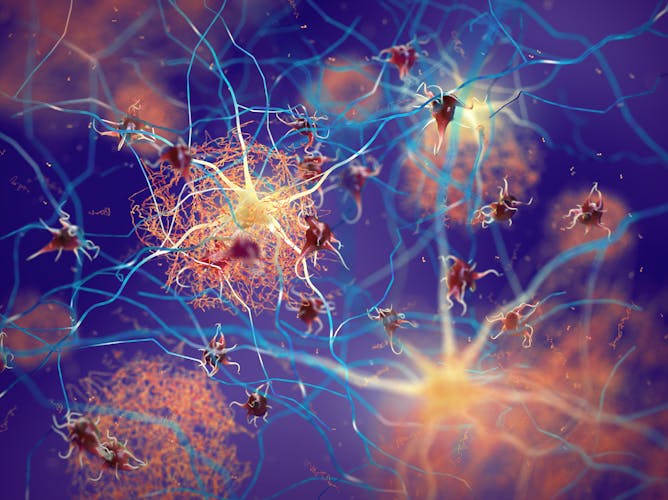
The cells which clear Alzheimer’s plaques from the brain follow a 24-hour circadian rhythm.
nobeastsofierce/ Shutterstock
Eleftheria Kodosaki, Cardiff University
If replicated in humans, these findings could mean that targeting or boosting the circadian rhythm in Alzheimer’s patients, could help with managing the disease
|
Politics + Society
|
-
Dan Taylor, The Open University; Ariel Hessayon, Goldsmiths, University of London
Struggles to uphold free speech throughout the centuries teach us that we should never take it for granted.
-
Andrew Payne, University of Oxford; Louise Fawcett, University of Oxford
To revive the 2015 nuclear deal with Iran, Biden must face down his political opponents in the US.
-
Theresa N. Kenney, McMaster University; Linzey Corridon, McMaster University
A straight cis-man could have made “herstory” as “America’s Next Drag Superstar.” Drag Race’s inclusion problem botches racialized queer histories, community discomfort and ally participation.
|
|
Environment
|
-
Sven Batke, Edge Hill University
Fussy about moisture and temperature, ferns are excellent indicators of environmental change.
-
Tom Cameron, University of Essex
Certain combinations of genetic material are being conserved through the generations.
-
Ifesinachi Okafor-Yarwood, University of St Andrews
Fisheries agreements favour the European Union and don’t do enough to protect African interests.
|
|
Arts + Culture
|
-
Alishya Dhir, Durham University; Clare McGlynn, Durham University
The show has been marketed as a feminist reclaiming, but at an emotional and traumatic cost to Pamela Anderson.
|
|
Science + Technology
|
-
Fabian Zander, University of Southern Queensland
How will they bring the structure back safely? And where will the surviving components crash?
|
|
| |
Featured events
|

|
— The University of Manchester, Oxford Road, Manchester, Manchester, M139PL, United Kingdom of Great Britain and Northern Ireland — University of Manchester
|
|
|
— Manchester Central Library, Manchester, Manchester, M2 5PD, United Kingdom of Great Britain and Northern Ireland — University of Manchester
|

|
— Online, Cambridge, Cambridgeshire, CB11PT, United Kingdom of Great Britain and Northern Ireland — Anglia Ruskin University
|

|
— University of Aberdeen, King's College, Aberdeen, Aberdeen, Aberdeenshire, AB24 3FX, United Kingdom of Great Britain and Northern Ireland — University of Aberdeen
|
|
|
|
| |
| |
| |
| |
| |
|
|
|
|
|
|
|
