Sharing our Annual Report & Impact Report, and welcoming new members to the team
No images? Click here


Thirty years ago, Ecotrust Canada set out with a bold idea: the environment and the economy don’t have to be in opposition—instead, they can support each other. Back then, it was a radical notion, encapsulated best in our mission to build a “conservation economy,” a phrase that we proudly note is in broad use today by governments, communities, and civil society.
Our mission took root in our early work with Indigenous partners, including the Haisla Nation, in creating the Kitlope Heritage Conservancy—the world’s largest intact coastal temperate rainforest.
It shaped our approach to “information democracy” when we used GIS technology to support Indigenous and rural communities in mapping their territories to manage their lands and waters.
It informed the creation of the Coastal Loan Fund, which helped rural entrepreneurs launch sustainable, equitable, and inclusive businesses. The fund lasted over 10 years and inspired a cascade of new conservation finance initiatives, which are increasingly being deployed around the world.
We’ve since pivoted from a sole focus on the “conservation economy” to a mission that considers conservation as one slice of a much larger pie. Our work on food, housing, energy, climate, and fisheries embraces the greater complexity of how human well-being and ecosystem health are deeply intertwined. In recognition of this interdependence, our mission now calls us to the more ambitious task of building an economy that provides for life.
That said, what has kept us going over the decades isn’t just a vision and a compelling mission—it’s a commitment to showing up, staying connected, and evolving alongside the rural, remote, and Indigenous communities we serve. We’ve always believed that real change happens from the ground up, and our job is to support that change with integrity, humility, innovation, and support for Indigenous sovereignty and leadership.
Our work today reflects the same core values we started with. Let me share just a few ways this has come to life in recent years:
- In Community Fisheries, after three decades of advocacy and partnership, we're now in a position to help reshape federal policy regarding how fish harvesting is governed on the West Coast of Canada—shifting the benefits of fisheries back into the hands of working harvesters, coastal communities, and First Nations.
- In Climate Resilience, we’re building on years of work—from the creation of community wealth through carbon offsets with the Cheakamus Community Forest in Whistler BC, to our partnerships with Wahkohtowin Development, a First Nation social enterprise in northern Ontario—to create place-based stewardship models that blend Indigenous law, ecological science, and climate action.
- In Food Systems, years of relationship-building through the North Coast Innovation Lab and fisheries work have led to meaningful partnerships. We’ve worked with Metlakatla First Nation to establish a regenerative ocean farm that grows scallops and seaweed and collaborated regionally to develop a local food hub in Prince Rupert. This work builds on our 28 years of living and working in the Skeena Region.
- In Community Energy, we celebrated a major policy win in 2024 when the Province of BC committed to covering the full cost of heat pump installations for lower-income households. That victory was grounded in years of hands-on work with communities and advocacy with aligned organizations and First Nations across coastal BC.
- In Indigenous Homelands, our Routes to Roots program focuses on regional economic development rooted in land and tradition, but it evolved from a long line of community partnerships, including our Tree-to-Home project, which were dedicated to linking resources and capacity to meeting local needs. More proof that long-term thinking and deep community ties can generate lasting, systemic change.
As we celebrate 30 years of this work, we know it’s not just our story—it’s a testament to what’s possible when communities lead, and when charities like ours have the courage and resources to follow, to serve, and to build. Together, we’ve proven that a different kind of economy is possible and is already taking root.
Now, we invite you to help it grow. Donate today.


New and Noteworthy
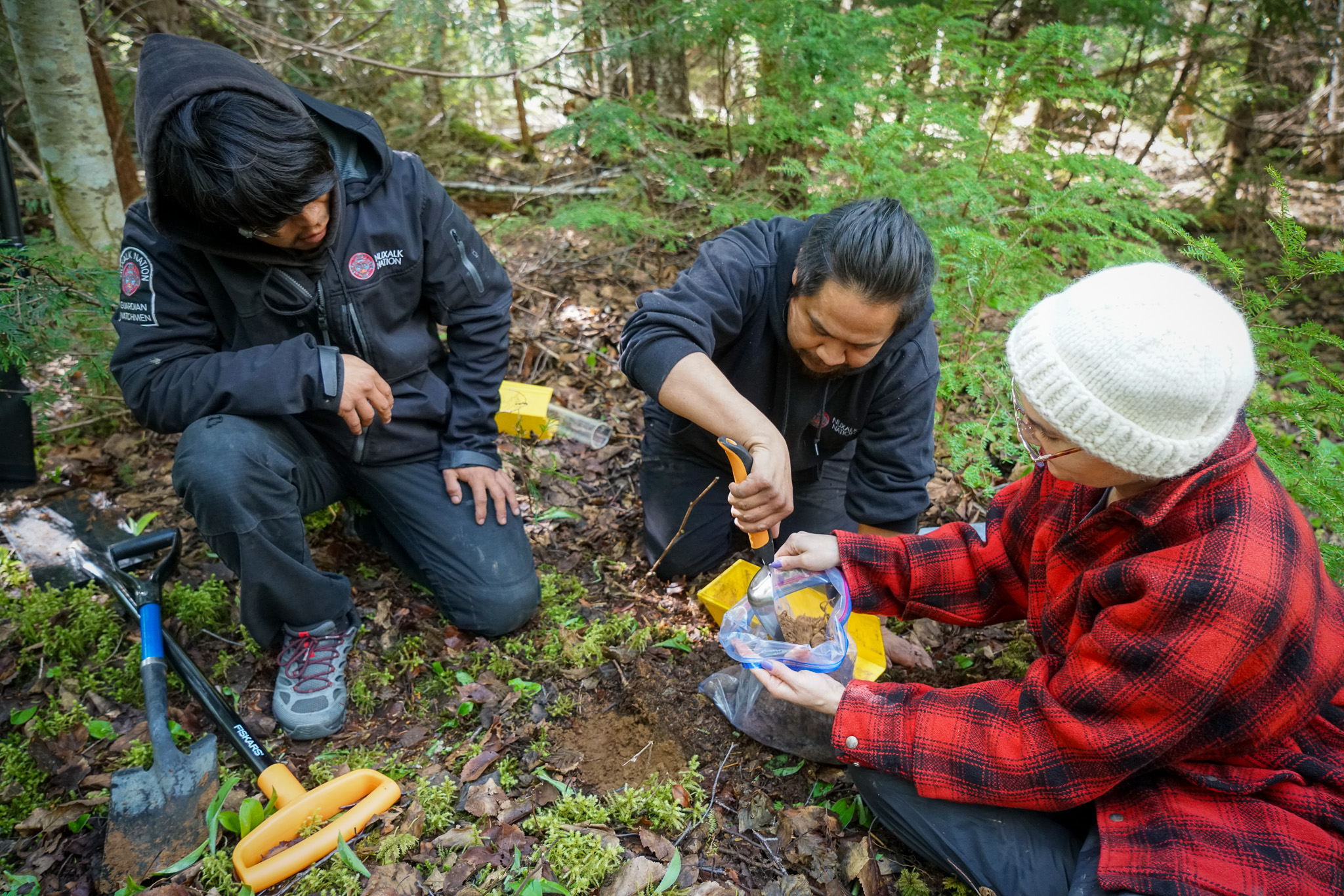
Highlights from working with Nuxalk Nation Guardians
This April, Caylin Sun visited Nuxalk Nation in the Great Bear Rainforest with our Climate Resilience team. They met with Nuxalk Coastal Guardian Watchmen, who took them into the forests and together they measured carbon stored in the soil. The ancient forests and rich soil layers were unforgettable, and the Guardians' stories were inspiring.
The Nuxalk Nation has purchased 181 hectares (about half the size of Vancouver’s Stanley Park) of private land to prevent logging and development. This protects forests on the Central Coast of BC so they can keep pulling carbon from the air and storing it in trees and soil.
To measure this carbon storage, they dug soil pits across each property and collected samples from different soil layers. Lab analysis revealed the amount of carbon each sample contained, which they used to estimate the carbon storage across the entire 181-hectare project area.
The Nuxalk Nation’s land protection project shows how local stewardship builds long-term climate resilience for generations to come. Our Climate Resilience program works with rural, remote, and Indigenous communities who are leading natural climate solutions in their territories, creating benefits for climate and biodiversity.

Like berries ripening on bushes in the summer sun, our team has been growing this season.
New to the Indigenous Homelands Program
Jalissa Schmidt has been hired as our Indigenous Education Specialist. She started on July 7 in a part-time capacity. Jalissa is dedicated to supporting and advocating for cultural revitalization and decolonization efforts, with clear intentions to support Indigenous equity, success, and belonging.
Becky Hill is a Graphic Designer who will be on contract with us for 1.5 years to work on two different projects, 1-2 days per week. Becky is also a beautiful illustrator, videographer, and web designer, and comes to us with a lot of experience working with Indigenous communities.
New to the Food Systems Program
Chelsey Wingfield is stepping in as our new Greenhouse and Garden Coordinator based in Prince Rupert on Ts’msyen Territory. Chelsey will be coordinating school and community garden spaces and supporting food programming, education, and community engagement efforts.
Canada Summer Jobs interns
Pavita Sidhu started on July 7 as our new Community Engagement and Research Intern with the Indigenous Homelands Program. Pavita, who is pursuing her master's in landscape architecture at UBC, is supporting ongoing work that addresses issues facing remote Indigenous communities in BC through a care-centred approach.
Jayne Stevens started as a Greenhouse and Garden Assistant with Food Systems on June 19. Since then, Jayne has worked on projects including documenting a Food Forest outside Roosevelt School in Prince Rupert and serving scallops at community events.
Zosia Stevenson started as a Communications Specialist on July 7. She will collaborate with the team on content creation, research, writing, and visual development for the upcoming staff gathering, which will celebrate our past and ongoing work in Prince Rupert.

Board Updates
We welcomed Dr. Tamara Krawchenko to the board this month, and we look forward to tapping into her extensive expertise on rural and regional development in Canada.
At the same time, long-term director Ron Grzywinski is stepping down from the board, having served with us since 2003. Throughout his term, Ron has been integral to the organization’s development, particularly in his role as Treasurer and through his service on our finance committee. Ron, who is widely acknowledged as a key architect of community development banking in the U.S., was critical in helping Ecotrust Canada shape its strategic approach to community development, business finance, and organizational governance. We would also like to acknowledge Ron for his kind, patient, and thoughtful style of leadership that helped pilot Ecotrust Canada through both calm and turbulent times. Thank you Ron, and we look forward to staying in close touch so that we can continue to celebrate our work with you!
30 Years of Proving the Possible
A series of reflections from our past three decades of work.
2008

In the late 2000s, growing consumer demand for transparency, specifically the story behind where their food came from, sparked a new initiative: could seafood be traced from ocean to plate? Ecotrust Canada worked with fish harvesters, processors, and retailers to co-develop ThisFish, an innovative tagging and tracking system.
By 2011, after 3 years of designing and testing the tracking system, ThisFish launched harvesters to tag their catch at sea with a unique code, letting consumers follow the journey from boat to table. In its first year, 230,000 fish were tagged, 270 harvesters and processors signed on, and 1,300 grocery stores, reaching an estimated 27 million people worldwide.
By 2017, ThisFish became a standalone social enterprise, earning accolades in the food tech space. More than software, it is a storytelling platform—building trust, rewarding responsible harvesters, connecting people directly to their food, and ultimately, proving the possible.

P.S. If you like this newsletter and want to support it, there are two ways you can do that.
1) Forward this newsletter to a friend with an invitation to subscribe right here.
2) Hit reply and let us know your thoughts about our latest Annual Report.

Proving the Possible
Ecotrust Canada works with rural, remote, and Indigenous communities toward building an economy that provides for a healthy and resilient natural environment; sustainable and abundant energy, food, and housing; prosperous and meaningful livelihoods; and vibrant cultures and inclusive societies. We call this approach, building an economy that provides for life.
Thank you for your continued support!
The Ecotrust Canada Team


