No images? Click here

StockedUp
Issue 8 | December 2025
For WA Sheep and Cattle Industries


A note from the editor: This will be our last edition for 2025, we wish you a very merry Christmas and happy new year, and will you see you at our next edition in 2026.
Season and production advice
- With summer in full swing, monitor water for livestock and ensure adequate, good quality water is available based on their animal requirements.
- It’s important weaners keep growing over summer. Know your target growth rate dependent on when you want to turn off. Make sure they are receiving adequate protein, energy and roughage. Find out more about weaner management in our factsheet, Growing weaner sheep.
- Supplementary feeding may be needed from early in summer in some areas. Feeding cereal grains with some roughage, such as hay, is advised if paddock FOO is low. Wheat poses a higher risk of acidosis than other cereal grains. Ensure any feed grain is introduced by slowly increasing the grain portion over at least 2 weeks while maintaining adequate roughage.
- Confinement feeding may be a strategy for sheep producers when paddock feed is limited. Confinement feeding may also be an option for mitigating erosion risk when ground cover is below 50%.
- Grazing dry pastures and stubble provides a valuable source of feed, however, quality decreases quickly in summer and it's important to monitor stock condition and start supplementing when necessary. Check out our feed budgeting tools and calculators to assist in feeding during summer and autumn.
- Preparing for joining boosts reproductive rates, lamb survival and genetic potential of your flock. For rams, conduct the 4T's test and feed high protein and energy grain or pastures for maximum sperm production, starting at least 8 weeks before joining. Check ewe condition at least a month prior to joining to assess if feeding is required to maintain their condition (3+). Check ewes' udders, feet and mouth condition – remove any affected ewes from the main flock and tease ewes if mating prior to mid-January.
- Testing feed is crucial for feed budgeting, but also for animal health. Knowledge of the nutritional value of your supplementary feeds and nutritional demands of your livestock allows producers to better select a supplementary feed source and how much to feed, preventing wastage whilst saving money. Other feed tests such as ARGT testing, chemical residue testing, mycotoxin screenings, and other contaminant testing can prevent poisoning in livestock.
- Phomopsis lesions have been found across the Northern and Central Wheatbelt. Phomopsis toxins cause lupinosis and the risk increases after summer rainfall.

Sheep industry update
Western Australia’s total sheep and lamb turnoff for nine months of 2025 reached 3.93 million head, representing a 19% decline year-on-year and tracking 7% below 2023 levels. Despite this reduction, slaughter volumes remain historically strong, particularly for adult sheep.
Domestic slaughter reached 3.41 million head, down 11% on the same period in 2024. Adult sheep slaughter totalled 1.37 million head, a 7% decrease, but remained high in a long-term context following two elevated years in 2023 and 2024. Lamb slaughter declined 13%, falling from 2.35 million in 2024 to 2.05 million in 2025, reflecting both a smaller 2024 lamb drop and the later seasonal flow of 2025 lambs.
Live export volumes totalled 267,200 head, an 8% decline from 2024. Kuwait remained the major destination, taking 101,200 head, though this was 27% lower than last year. Trade remained subdued following the northern hemisphere summer moratorium and slower-than-usual resumption of shipping activity.
Interstate transfers fell sharply to 251,900 head, a 66% reduction from the unusually large 748,900 head moved in 2024. Both categories declined, with adult sheep transfers down 82% and lamb transfers down 50%. Lambs comprised 74% of all east-bound movements.
Lamb slaughter accounted for 52% of total turn-off, sheep slaughter for 35%, live export for 7%, and interstate transfers for 6%. The substantial fall in interstate transfers was the major driver of the overall turn-off decline compared with 2024, when strong eastern demand absorbed a far larger share of WA supply.
Flock modelling indicates that the WA flock, estimated at 12.4 million head in mid-2022, has likely declined to between 8.6 and 9 million head by July 2025. Elevated turn-off across 2023–2024, driven by seasonal pressure, low prices and uncertainty around the Australian Government’s live export phase-out, contributed to the reduction. However, improving prices and stronger seasonal conditions through 2025 have slowed the sell-down, increasing the likelihood of stabilisation—or potential flock recovery—entering 2026 if favourable conditions continue.
Get your plan ready: animal welfare in emergencies

Owners of livestock, companion animals and horses are being urged to develop a Plan for Animal Welfare in Emergencies (PAWE) to include in their household bushfire and emergency plans, before summer conditions escalate.
Have your PAWE ready to go as part of household bushfire and emergency plans. Being ready means testing your readiness to implement the plan and ensuring your equipment/trailers are in good condition and practiced.
In the event of a natural hazard emergency, it is critical not to leave it too late to implement emergency plans and risk the safety of animals and their owners. If animals cannot be evacuated, it is important to identify a safe place for them to shelter, along with sufficient food and water for a prolonged period.
PAWE templates for bushfires, as well as cyclones, floods, storms and heatwaves, are available on the DPIRD website.
Stay up to date during an emergency using the Emergency WA website or app, the Department of Fire and Emergency Services (DFES) Facebook page, and listening to ABC Local Radio.
Image source: DPIRD
Annual Ryegrass Toxicity (ARGT) in Livestock

Annual ryegrass toxicity (ARGT) is a potentially fatal poisoning of livestock after consumption of annual ryegrass infected by the bacterium Rathayibacter toxicus. The toxin producing bacterium are carried into the ryegrass by a nematode (Anguina funesta). The nematode invades the developing seeds of the ryegrass, replacing it with nematoda galls (abnormal growth on plants).
Nematode galls are not toxic and cause no resulting disease when consumed by animals. However, if the bacterium is attached to the nematode it will begin to grow and produce a bacterial gall with subsequent production of the toxin (corynetoxin) that causes ARGT. Infected ryegrass remains toxic even when it has senesced and dried off. Hay containing infected ryegrass will also be toxic.
All grazing animals are susceptible, including sheep, cattle, horses and pigs. The toxin is cumulative, which means the more the animal consumes, the greater the impact and clinical disease. Signs of ARGT in livestock may appear as soon as four days or as late as several weeks after animals are introduced to toxic feed. ARGT causes neurological signs which are exacerbated by stress or activity, such as yarding or mustering.
In cattle and sheep, ARGT appears as incoordination, falling over, convulsions often with the head thrown back and stiff limbs, and abortion in pregnant stock. In horses, ARGT appears as reduction in eating, slow muscle tremors, incoordination, disorientation, reactivity to stimuli and seizures. There is no specific treatment for ARGT. The priority is to remove the stock from the contaminated feed source. If shifting paddocks, move the animals calmly and slowly. Provide affected stock with shade, clean water and fresh hay. It can take up to six months to clear all effects of the toxin.
ARGT can be prevented with daily inspections of grazing stock, good biosecurity to minimise introduction of the ARGT-causative organisms, paddock management and testing of feed sources for ARGT. When buying hay, it is recommended that you ask for a vendor declaration before purchase and ask if ARGT testing has been done.
Vendors are encouraged to provide evidence of results through the sighting of their test results direct from DDLS – this shows the risk rating on their samples. Suitable declarations and more information is available from Integrity Systems. Testing of ryegrass in paddocks or hay bales can be used to identify safe feed material for livestock.
For further information on ARGT testing, please contact DDLS laboratory on +61 08 9368 3351 or ddls@dpird.wa.gov.au. Certain emergency animal diseases not present in Western Australia have similar signs to ARGT, such as scrapie in sheep and Hendra virus in horses. If you see any unusual signs of disease, abnormal behaviour or unexpected deaths in stock, call your private veterinarian, your local DPIRD field veterinary officer, the Emergency Animal Disease hotline on 1800 675 888 or MyPestGuide Reporter via the app or online.
Read more on DPIRD’s webpage about annual ryegrass toxicity in livestock
Image source: Testing hay for annual ryegrass toxicity (ARGT) risk: agric webpage.
Summertime suffering with Stomoxys calcitrans: The stable fly

Stable flies can be a serious pest of livestock around animal enclosures, stables, feedlots, and paddocks or pastures. The constant biting and agitation of the flies can lead to animal welfare issues and production losses.
Stable flies breed in rotting organic waste such as manure, compost, grass clippings, hay and vegetable waste. Controlling rotting organic waste is critical to reducing the impact of these horrible biting flies.
Follow these hygiene practices to reduce stable fly breeding on your property:
Feeding out in a paddock
- Use hard-stands or troughs where possible to reduce the food mixing with the soil
- If feeding directly onto the ground, place feed in long thin lines to reduce the feed from being trampled or defecated on.
Hay
- Hay takes a long time to break down. If hay residue fed out in summer becomes wet and mixes with soil, urine or faeces it can create a suitable breeding environment for stable flies in the following season.
- Spreading out soiled hay thinly will not kill the larvae
- To prevent stable fly breeding in soiled, inedible hay, it must be either buried (1 metre deep) or sprayed with a pesticide and left undisturbed to allow any emerging flies to contact the chemical residue/barrier.
Weekly hygiene measures
- Remove animal manure and spilled grain from pens, yards, water troughs and under fences or gates. Spread into thin layers on the ground to dry out
- If manure or waste bedding must be stockpiled, ensure it is for less than 3 days, otherwise it must be covered and sealed with a fly-proof and waterproof cover
- Bury waste organic material and cover with soil to a depth of 1m.
These measures can be found in the Stable Fly Biosecurity and Agriculture Management Plan.
Please report problems with stable fly
If, after ensuring you have addressed all possible breeding areas, stable flies continue to cause problems to your animals, please report to your local government authority.
Field day success at Katanning Research Station

Attendees of the 2025 Katanning research station sheep field day had the opportunity to view the 2024-drop Yardstick ewe-hoggets off shears and the Yardstick wether-hoggets in full wool. All data collected so far including fleece weights for the shorn ewes and indexes were presented.
KRS Manager and Team Leader Keren Muthsam welcomed attendees and presented some highlights at KRS so far. Keren also mentioned the favourable season to date. Executive Officer of the Australian Merino Sire Evaluation Association – Ben Swain, presented the results of the 2024-drop Yardstick progeny
Georgia Welsh, a PhD student at Murdoch University shared some preliminary findings to date on the effect of laming into shrubs and dual-purpose crops on lamb survival. Brittany Bolt from DPIRD Katanning presented an update on the Sheep Feed Intake Facility (SFIF) at KRS and the work in the SFIF to show the potential to select more feed efficient sheep which produce less methane
Claire Macleay from DPIRD Bunbury spoke about an opportunity to do some feed intake measurements on the Yardstick ewe hogget progeny. Beth Paganoni from DPIRD Bunbury, Shamshad Hassan from DPIRD Bunbury and Bronwyn Clarke (Murdoch University) spoke about a future project and the opportunity to breed robust and resilient sheep. Umair Khan from DPIRD Katanning shared his findings on methane production from sheep at KRS using the Greenfeed machines.
Approximately 65 attended the field day, who were a mixture of stud breeders, sheep producers, supply chain participants and interested onlookers. Many attendees commented on the outstanding presentation of the research station.
Image source: Jane Coakley (DPIRD)

Our staff
Meet John-Paul Collins,
John Paul (JP) has spent his 20-year career with DPIRD living and working in regional WA. JP has called Katanning home since the early 2000’s where he initially worked on an AWI – funded project working with producer groups to rehabilitate salt-affected land with salt-tolerant species for livestock production.
He has also worked in projects related to precision agriculture in cropping and providing timely advice to producers via tactical web-based newsletters and other media. Since 2015, he has worked in livestock, initially on a Royalties for Regions funded project exploring labour-saving technology to improve sheep management. This led to a request to manage the Yardstick project, which is a sire evaluation trial measuring the progeny of a range of leading merino sires in partnership with key industry groups and stud breeders.
More recently he has been heavily involved in the plan for Katanning Research Station (KRS) to become carbon neutral. This has included rehabilitating the salt-affected areas of KRS with outcomes focused on restoring native biodiversity and improving grazing production on saline land which is not suitable for cropping.
JP has gained a wealth of knowledge and experience in saltland rehabilitation, agricultural technology, regional development and livestock production and is committed to seeing the livestock industry grow and create economic development opportunities for regional Western Australia.
Image source: John-Paul Collins (DPIRD)

Latest n-ewes
- Opportunity knocks following WA offering at China trade expo
- Australian beef industry sets global benchmark in sustainability performance
- Removal of US tariffs on Australian beef: statement from Michael Crowley, Managing Director of MLA
- Closing the Economic Yield Gap of Grain Legumes in WA
- Industry first: AUS-MEAT approves MEQ Camera technology
- Sterile flies strike back on economic loss
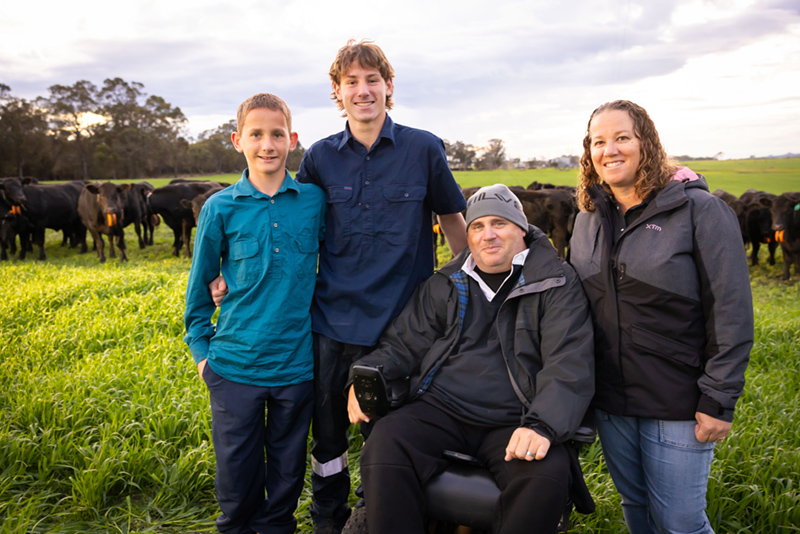
- Breaking down barriers to success- Innovative WA beef producers Kent and Michelle Rochester are reaping the rewards of embracing ag-tech.
Events
- Business EDGE | Meat & Livestock Australia | Dec 4-5, Pilbara WA
- Leading the Herd Program - Western Beef | Please see event info for dates and locations
- West Tech Fest | Dec 8-12, Perth WA
- Rumen-8 Beef Workshop | Dec 15, Bunbury WA
- GRDC Grains Research Updates 2026 | Feb 16-17, Perth WA

Further information
WA Sheep and Cattle Industry news from the Department of Primary Industries and Regional Development (DPIRD). If you have any questions, or require further information please email livestock@dpird.wa.gov.au
Subscribe to StockedUp Livestock Industry news
Important disclaimer
The Chief Executive Officer of the Department of Primary Industries and Regional Development and the State of Western Australia accept no liability whatsoever by reason of negligence or otherwise arising from the use or release of this information or any part of it.
Copyright © State of Western Australia (Department of Primary Industries and Regional Development), 2024.


