No images? Click here


In this issue of CODA Connect, we welcome new partners, spotlight CODA Partner Hiber, and release our latest report on Australia's decommissioning regulatory landscape. You'll also find updates on our new online learning module, recent webinars and podcast episodes, partner news, and the latest research insights from the NDRI.
CODA's Growing Partner Network
We are proud to welcome a number of new organisations as part of our partnership program.


Join CODA’s Partnership Program
CODA’s Partnership Program is open to companies of all sizes in the decommissioning value chain. Our partners receive access to full versions of our Forward Outlook and Waste Facilities databases, reports, studies, their associated materials, and more.
Partner Spotlight: Hiber

Hiber delivers field-tested, end-to-end solutions for remote well pad monitoring, engineered to perform in the harshest environments. Its flagship offering, HiberHilo, is a end-to-end remote monitoring solution for upstream oil and gas, combining rugged hardware, intuitive software, built-in connectivity, and expert support in one integrated system.
As modern oil and gas operations extend into increasingly remote and complex environments, operators must also manage aging infrastructure and end-of-life assets with greater care and efficiency. HiberHilo was developed to address these evolving challenges, enabling continuous remote visibility across both active and late-stage operations. By providing real-time data on well and pipeline integrity, HiberHilo enables predictive maintenance, allowing engineers to visit sites only when necessary and significantly reducing operational costs. Instant alerts and live monitoring also minimize downtime, boost productivity, and enhance worker safety.
Technology and Hardware

L to R: Temperature Sensor, Differential Pressure Sensor, Pressure Sensor, Wireless Bridge, LoRaWAN Gateway
At the core of HiberHilo is a suite of industrial-grade end devices purpose-built for oil and gas applications. Designed for durability, these sensors perform reliably in extreme conditions, from scorching desert heat and arctic snowfields to dense rainforests and offshore environments during monsoon seasons, delivering critical operational data in real time. These devices are engineered for rapid and straightforward installation, with training and support provided by Hiber and accessible at any time through the Hiber Dashboard. A key differentiator is Hiber’s use of LoRaWAN technology, enabling connectivity across wells, platforms, and assets up to an 8-10 km radius. This reduces the need for complex wired infrastructure and multiple field devices, driving both operational simplicity and cost efficiency. HiberHilo also offers flexible network connectivity options to suit a wide range of operational requirements and field conditions.
View Hiber's range of end devices - hiber.global/end-devices
Software Integration and Reporting

HiberHilo Dashboard
Operators benefit from customizable dashboards, seamless integration into existing workflows, and year-round managed services, ensuring continuous performance, reliability, and support. Data collected can be easily exported and used for automated reporting, including compliance reports for government and regulatory bodies.
Applications

OFFSHORE
Hiber supports remote monitoring for offshore platforms, including plug and abandonment projects in the North Sea, aging assets in Trinidad and Tobago, and operations in Brunei where access is limited during monsoon seasons. These deployments are particularly valuable for decommissioning activities, where continuous monitoring reduces the need for frequent and costly site visits while maintaining safety and compliance.
ONSHORE
In extremely remote regions such as Australia’s Northern Territory, HiberHilo enables an operator to monitor assets located days away from its nearest access point. In these challenging environments, often requiring long travel times and posing natural hazards, real-time pressure monitoring ensures regulatory compliance while significantly reducing the need for physical inspections.
With operations and local partners worldwide, Hiber’s award-winning technology is easy to install, simple to manage, and built to scale anywhere on earth.
More Information
For more information on Hiber and its wireless monitoring technology, please visit their website.
Updates From CODA

Latest Report is Now Available
This report examines Australia’s decommissioning regulatory landscape, shaped by layered and sometimes overlapping legislation, alongside evolving expectations. It draws on regulatory mapping and industry consultation to better understand how the current system is applied in practice, and to identify opportunities to improve clarity, consistency, and efficiency.

First Online Training Module Released
Our first online training module, Introduction to Well Decommissioning, is now available.
Developed in response to strong demand for our in-person training, this new self-paced module provides a flexible learning option for those unable to attend our in-person Introduction to Decommissioning course, as well as individuals and organisations looking to build capability for themselves or across their teams.
This module covers the well lifecycle, with a focus on plugging and abandonment, including key steps, regulatory frameworks, and planning considerations.

Decommissioning Forward Outlook Updated
We’ve recently published the latest update to our Decommissioning Forward Outlook dashboard, with a focus on improving data quality, consistency, and usability across the platform.
This update includes enhancements to the Outlook’s AI capability, enabling more accurate identification of offshore activities, alongside a broader review of the dataset to address duplication, align lifecycle stages, and refine activity definitions. The Outlook is now supported by a rebuilt platform, allowing for faster updates and greater granularity across activities and timelines.

Harriet Alpha Decommissioning Progress Visit
Members of the CODA team has the pleasure of participating in a site visit to the Harriet Alpha assets following their arrival at the Australian Marine Complex (AMC) in Henderson, providing an opportunity to observe progress on the offshore removal and onshore dismantling phases of the project.
The Harriet Alpha decommissioning scope represents a significant example of the growing capability of the Australian offshore decommissioning sector. It sets a new benchmark for scale and execution, and reflects the progression toward a growing number of large-scale decommissioning programs across the industry.
CODA acknowledges and congratulates all project teams involved in delivering this stage of the work.

Thanking Our Latest Access Program Participants
We'd like to extend a big thanks to Nicola Morgan, Sarah Mullins, and Carla Machin, for attending our recent Intro to Decommissioning course as part of our Access Program.
The program is designed to help improve access to decommissioning education and broaden industry participation by providing complimentary places to selected applicants who may not otherwise have the opportunity to attend.
Latest Webinars & Podcasts

Podcast: Planning for Future Decommissioning in Norway
CEO Francis Norman speaks with representatives from Offshore Norge about how Norway is preparing for the next phase of offshore decommissioning.

Podcast: Research & Innovation in Well P&A
CEO Francis Norman speaks with Harald Linga from SFI SWIPA about the role of research and collaboration in advancing well plugging and abandonment.

Podcast: The Evolution of Decommissioning Conferences
CEO Francis Norman is joined by Tommy Angell and Rachael Brand from Offshore Network Ltd. to discuss the evolution of decommissioning conferences and the growing momentum across the sector.

Webinar: Exploring an Alternative Approach to Subsea Pipeline Removal
CEO Francis Norman is joined by Darren O'Leary, Managing Director of Restore Subsea, to discuss an alternative approach to subsea pipeline removal.

Webinar: Integrating Carbon, Cost, Risk, and Nature in Decommissioning Strategy
General Manager Rean Gilbert is joined by Dr Rachel Gavey and Nicola Morgan from sustain:able to explore how carbon, cost, risk and nature can be integrated into decommissioning decision-making.

Webinar: Passive Technologies for Risk-Based Well Decommissioning
General Manager Rean Gilbert is joined by Jim Gordon, Business Development Manager at Sentinel, to explore how passive technologies are being applied to support risk-based well decommissioning.

Webinar: Decommissioning Innovation from SICA Members
This session is delivered in collaboration with CODA Partner Subsea Innovation Cluster Australia (SICA), showcasing a range of technologies that support decommissioning across the Australian offshore sector.

Webinar: Marine Solutions for Offshore Decommissioning
CEO Francis Norman is joined by Peter Carmichael, Executive General Manager of Strategy and Business Development at Bhagwan Marine, to discuss marine solutions for offshore decommissioning.

Webinar: Challenges of Heavy Lift Operations in Offshore Decommissioning
In this webinar, CODA Partner Claxton walks through the technical realities of preparing offshore structures for heavy lift, from well abandonment and conductor recovery through to jacket cutting and cut verification.
Industry & CODA Partner News

INDUSTRY
NOPSEMA has released Australia’s Offshore Energy Industry Performance Report 2025, providing an overview of offshore energy activity and performance across Australia’s regulated jurisdictions, based on annual data up to and including the 2025 calendar year.
The report draws on regulatory data, inspection and assessment findings, and engagement insights. It covers offshore petroleum and greenhouse gas storage activities regulated by NOPSEMA, and offshore renewable energy activities regulated by the Offshore Infrastructure Regulator.

JAMES FISHER
CODA Partner James Fisher and Sons plc (James Fisher), a global provider of specialist marine and energy solutions, will share information on new technologies at D&A Australia in Perth on 23-24 June.
These include SEABASS™ and SEABASS™-MLS; a modular rigless well plug and abandonment system used in the North Sea, and JetFlow 100 – a powerful controlled flow excavation tool which cuts through soils and clays and provides mass flow excavation in a single pass.

IMCA
The International Marine Contractors Association (IMCA) has published new industry guidance designed to improve safety during subsea decommissioning and dismantlement projects, warning that ageing offshore infrastructure, incomplete historical records and changing site conditions are creating an increasingly high-risk environment for commercial diving operations.
You Might Be Interested In

23-24 JUN 2026, PERTH - AUSTRALIA
D&A AUS 2026
CODA will be once again partnering with Offshore Network to bring the conference to The Crown, Perth on 23-24 June 2026.

1-2 DEC 2026, BANDAR SERI BEGAWAN - BRUNEI
SPE SYMPOSIUM:
ASIA PACIFIC SUSTAINABLE FACILITIES DECOMMISSIONING
Call for abstracts open until 3 August 2026
The symposium aims to bring together operators, regulators, service providers, technology innovators, and subject matter experts to exchange practical insights, share lessons learnt, and explore forward-looking solutions shaping the next phase of asset retirement across the region.

NDRI (National Decommissioning Research Initiative) Update
The NDRI continues to do important research to better understand the impacts of decommissioning oil and gas structures on the Australian marine environment.

NDRI Commences Environmental Life Cycle Assessment of Offshore Oil and Gas Decommissioning
The NDRI is pleased to announce the commencement of a new research project focused on the application of Life Cycle Assessment (LCA) to evaluate environmental impacts of offshore oil and gas decommissioning activities in Australia.
As Australia progresses towards larger-scale offshore decommissioning activities, understanding the full environmental implications of different end-state options becomes increasingly important. Life Cycle Assessment is a recognised approach used to evaluate impacts across the full life of an activity or process. In the context of offshore decommissioning, it will be adapted to enable evaluation of direct and indirect environmental impacts to be considered across the broader decommissioning pathways and scenarios under Australian conditions. Importantly, the project will extend beyond offshore removal activities to consider the environmental implications of transport, onshore processing and waste management, and the fate of residual materials and contaminants.
Ultimately, the project aims to deliver a more holistic understanding of environmental outcomes across the decommissioning lifecycle. In doing so, it will examine key drivers of risk and impacts, critical data gaps and areas of uncertainty.
Further updates on this project, including who we are partnering with, will be shared very soon.
If you're interested in learning more about this project or NDRI, head to our website or follow us on LinkedIn

New Research Paper Added to NDRI Library
Authored by Anaëlle Julie Lemasson and Antony Knights, this paper explores the environmental effects of offshore oil and gas decommissioning through a global systematic review of marine ecological outcomes.
The review found that while decommissioned offshore structures can support diverse marine ecosystems, there is still limited empirical evidence comparing different decommissioning approaches. The authors also highlight major knowledge gaps, particularly around long-term monitoring and southern hemisphere case studies.
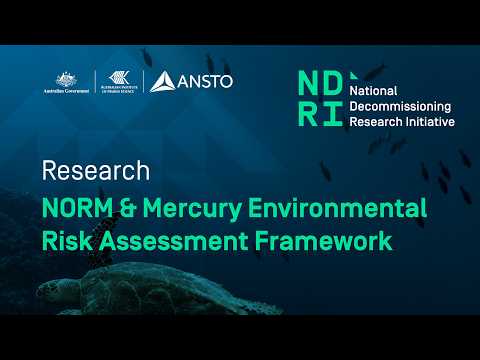
New Video Released
Our latest video gives a quick introduction to the NDRI Environmental Risk Assessment Framework for the Offshore Decommissioning of NORM and Mercury-Contaminated Oil and Gas Infrastructure.
A big thank you to all involved in producing this, including Garnet Hooper (NOPSEMA), Darren Koppel (Australian Institute of Marine Science), Tom Cresswell (ANSTO), Jenny Stauber, and of course Ian Bignell, Jesse Bartlett, and the rest of the team at tsp studio.


