
December 2025
Welcome to our last Quarterly Review of 2025. Here, we look ahead to they key agenda points for Boards and leadership in 2026, approaching the new year with a positive outlook.
We continue to be busy across Board and c-suite appointments (including FTSE100 and 250 Chair, NED and CFO successes in the past few months), as well as key Board Performance Reviews for major international listed and private groups.
We would like to take this opportunity to thank you for your ongoing support to us and the business, and wishing you a great and successful year ahead. Thank you!
Andrew Hayward

Why CEO Turnover Is Rising in 2025
Harvard Business Review explores the sharp rise in CEO turnover in 2025, that unlike in previous years, is no longer being driven primarily by poor company performance. New data shows that high-performing companies are now almost as likely as low-performing ones to change their CEO. Turnover among S&P 500 CEOs in the top three performance quartiles reached 12% in 2025, compared with 14% in the bottom quartile, narrowing the previous year’s gap (7% versus 18%). Overall succession rates climbed to 12.5%, up from 9.8% in 2024, reflecting both a return to historic norms and a proactive shift in how boards manage leadership transitions.
This increase is largely due to strategic board decisions rather than crises or underperformance. Forced CEO exits declined to 15.2% from 16.3%, the first decrease since 2020, suggesting boards are using succession as a forward-looking tool. Several factors are driving this behaviour. Many previously deferred transitions are now taking place, as long-serving CEOs who stayed through post-pandemic instability step aside. The average tenure of departing CEOs rose from 7.4 years in 2024 to 9.3 years in 2025. Boards are also treating market volatility, shaped by AI disruption, geopolitical tensions and regulatory shift, as a permanent fixture, prompting them to seek leaders better suited to navigating ongoing uncertainty.
This environment has reshaped where boards look for leadership. External CEO appointments almost doubled to 32.7% in 2025, pushing internal promotions below 70% for the first time in eight years. Boards are increasingly seeking fresh perspectives and new capabilities, while still recognising the importance of building strong internal pipelines. Interim CEO appointments remain relatively elevated at 14.9%, indicating that succession planning is still not consistently embedded as an ongoing governance discipline.
The article recommends integrating succession planning into annual reviews and risk oversight, developing next-generation leadership talent, monitoring external CEO markets and updating competency frameworks to reflect the demands of a volatile operating environment. In an era defined by disruption, Boards that institutionalise proactive and consistent succession planning will be better equipped to drive long-term value creation.

EY Board of the Future Study: What is the agenda for
reimagining more strategic, future-looking boards?
The EY Board of the Future study highlights growing pressure on global boards, with many Non-Executive Directors warning that the current governance model is becoming unsustainable. Directors report being overloaded by rising regulatory demands, rapid technological change, geopolitical volatility and expanding stakeholder scrutiny. In interviews covering 90 boards, 35% of directors said existing governance approaches are not sustainable, and a further 47% consider them only “somewhat sustainable”. Boards are struggling to keep pace with a business environment EY describes as NAVI (Non-Linear, Accelerating, Volatile and Interconnected) leading to reduced strategic foresight and increasing risk of oversight failures.
The study finds that Board workloads have risen sharply, often leaving directors with insufficient time for strategic engagement. Many report receiving unwieldy volumes of information, sometimes exceeding 1,500 pages per meeting, while director compensation has barely grown in real terms, rising only 1% from 2014 to 2024. This misalignment contributes to what one director called the end of the “golden age” of Non-Executive Directorships. The research also highlights significant effectiveness gaps, including suboptimal Board–management relationships, over-filtered information flows, limited opportunities for future-focused dialogue, and challenges in interpreting non-financial performance drivers such as culture, sustainability and risk. Only 19% of directors feel they can easily form a reliable view of non-financial drivers across global operations.
To address these shortcomings, EY proposes a six-part “6E agenda” designed to reimagine governance. This includes Elevating efficiency by redesigning board processes and using technology to reduce workload; Enhancing effectiveness through stronger trust, professionalisation and improved board–management dynamics; and Exercising foresight by engaging external ecosystems, increasing scenario analysis and injecting fresh perspectives into board composition. The agenda also calls for Encouraging independence, with directors urged to embrace contrarian thinking and strengthen internal audit and risk insight; Engineering simplicity by streamlining global governance structures, integrating principles-based frameworks and improving visibility across complex multinational entities; and Employing AI, which boards currently underuse despite its potential to enhance oversight, generate real-time insights and support strategic decision-making.
Seizing the agentic AI advantage: A CEO playbook to solve the gen AI paradox and unlock scalable impact with AI agents
McKinsey's report on Seizing the agentic AI advantage argues that organisations are at an inflection point as agentic AI, systems capable of autonomously planning, acting and collaborating, moves from concept to deployment. It highlights sharp regional differences in readiness, with European organisations appearing more cautious and less prepared than global peers. European respondents report lower organisational knowledge of autonomous agents - only 48% say they know “a lot” about them, compared with notably higher levels in the United States and China. They also report greater difficulty recruiting talent with the required technical and specialist skills, again trailing global counterparts on this measure .
The report notes, however, that Europe’s more conservative stance does not diminish the opportunity. Instead, the authors argue that European business leaders must act quickly to avoid falling behind more aggressive early adopters. They emphasise that European organisations may have advantages to build on, including long-standing investment in governance, risk management and responsible AI frameworks - key safeguards required before agentic systems can be deployed safely at scale. But overall, on measures of knowledge, adoption and skills readiness, Europe lags, suggesting that leaders must accelerate capability-building and strategic experimentation to remain competitive as agentic AI becomes mainstream .
More broadly, the report identifies three core drivers of the agentic AI opportunity: rapidly advancing technical capabilities, the shift from task-based automation to goal-oriented autonomous systems, and the potential for dramatic productivity improvements. It argues that businesses that successfully integrate human and agent collaboration will unlock exponential value by redesigning workflows, decision cycles and operating models. However, it stresses that value realisation depends on careful governance and workforce preparation, including structured training, risk controls and investment in cross-functional AI literacy programmes.
A series of recommendations for leaders are presented, including establishing clear guardrails before deploying autonomous agents, prioritising workforce upskilling, experimenting with agentic use cases that offer measurable ROI, and evolving governance models to maintain trust and safety. For the UK and wider Europe, the message is explicit: organisations must close the knowledge and skills gap quickly or risk being outpaced by markets where agentic AI adoption is already accelerating. The report concludes that those able to pair strong governance with confident implementation will gain a decisive competitive advantage in the next wave of AI-enabled transformation.
Fall in Board pay drives fears top directors will shun London
The Financial Times explores new research from Alvarez & Marsal showing that payments to UK Non-Executive Directors have fallen sharply in real terms over the past decade, fuelling concerns that London-listed companies may struggle to attract high-calibre board talent. Median base fees for FTSE 100 NEDs have lagged consumer price inflation by 11.8%, even as regulatory expectations, workload and complexity have increased. The report warns that without more competitive pay, companies will only be able to recruit individuals who have already accumulated significant wealth, and that relying on prestige rather than remuneration is “dangerous” for the health of UK Boardrooms.
The disparity with the US is particularly striking. According to the research, US-listed companies of similar size pay non-executive directors roughly three times more than FTSE 100 groups. The article notes several examples: NatWest pays its NEDs £88,000, compared with about $285,000 (£215,000) at US Bancorp; Unilever pays £95,000, while PepsiCo pays around $320,000. Median FTSE 100 NED fees stand at £81,000, with chairs receiving £475,000 and committee chairs typically between £17,000 and £27,000. This widening pay gap, combined with a recent decline in companies choosing to list in London, raises further questions about the City’s global competitiveness.
The UK government and the Financial Reporting Council have attempted to respond by updating guidance to encourage greater share-based remuneration for NEDs, aiming to help listed companies attract internationally competitive board members. However, the Alvarez & Marsal report shows that only 3% of FTSE All-Share companies currently offer shares as part of NED fee structures, and just 13% have shareholding guidelines. This contrasts sharply with the US, where 60–70% of non-executive fees are commonly paid in shares. The report cautions that adjusting fee structures alone will not close the competitiveness gap unless the overall value of compensation is also increased.
Alongside pay concerns, investor pressure against “overboarding”, holding three or more board seats, has intensified. Alvarez & Marsal notes that the pool of individuals able to take on these responsibilities at current UK remuneration levels is shrinking. With companies such as AstraZeneca exploring a greater US presence and some groups choosing New York over London for listings, the report underscores fears that remuneration weakness could further erode the UK’s ability to attract and retain top board talent at a time when governance expectations continue to rise.
Retail 2026 Report
Retail Week's Retail 2026 report, based on interviews conducted by Retail Week journalists between May and July 2025 with 45 UK retail leaders, after years of navigating an unforgiving macroeconomic landscape, UK retailers are heading into 2026 with cautious optimism and a renewed sense of strategic clarity.

We are entering a defining period as economic stagnation, inflationary aftershocks, shifting consumer expectations and accelerating technology adoption reshape the retail landscape through 2026. While global macroeconomic pressures remain, the UK faces a particularly challenging environment: weak GDP growth, strained household finances and high relative inflation (the highest in the G7 during parts of the period). Consumers across Europe and the UK continue to trade down or delay purchases, heightening the focus on value, durability and “buying better” rather than simply buying cheap. Against this backdrop, retailers must navigate rising costs, cautious spending and persistent supply chain pressures while maintaining investment in digital capabilities and transformation initiatives.
At the same time, environmentally responsible consumption is becoming a structural expectation in UK and European markets. Consumers increasingly demand products that are “good for the planet”, with durability, repairability and reduced environmental impact emerging as mainstream purchasing drivers. Regulatory pressure, from extended producer responsibility rules to stricter sustainability labelling standards, is accelerating this shift across Europe, requiring retailers to adapt propositions, sourcing strategies and product lifecycles. Brands that cannot demonstrate ecological credibility risk being rapidly deprioritised by consumers, investors and regulators.
Technology, particularly AI, automation and advanced data analytics, is identified as the most powerful catalyst of competitive advantage by 2026. The report emphasises the rise of highly automated fulfilment, personalised digital experiences, algorithm-driven merchandising and integrated omnichannel operations. For UK and European retailers facing margin compression, these technologies are not optional: they are essential for cost efficiency, accurate forecasting, workforce optimisation and customer relevance. The report notes that retailers who align technology investment with operational redesign, not simply digital upgrades, will pull ahead of slower adopters.
Ultimately, the report concludes that retail success in 2026 will depend on the industry’s ability to combine resilience with reinvention. Winning retailers in the UK and Europe will be those that: (1) rebuild trust with value-conscious consumers, (2) deliver demonstrably sustainable products and operations, (3) integrate technology deeply across all functions, and (4) form strategic partnerships to enhance capability and flexibility. Against an unstable macroeconomic backdrop, the retailers that adapt to these expectations, rather than wait for conditions to stabilise, will be best positioned to grow, retain loyalty and strengthen long-term competitiveness.

Global M&A Insights Report
SI Global's 2025 Insights Report finds M&A activity shaped by persistent macroeconomic turbulence, resulting in deal volumes falling 8% year-on-year. After a strong end to 2024 and an optimistic first quarter, momentum stalled in Q2 as high inflation, “higher-for-longer” interest rates and geopolitical uncertainty weakened buyer confidence. The introduction of new US tariffs also prompted risk-averse behaviour, contributing to delays, repricing and valuation gaps. However, sentiment improved by Q3 as tariff concerns eased and the AI boom helped stabilise public markets. Survey data shows renewed optimism, with 70% of buyers expecting deal volumes to rise over the next 12 months .
Across regions, performance has diverged sharply. The UK remained comparatively robust, even as Continental Europe saw an 18% decline in M&A activity year-to-date. The European outlook for 2025 depends heavily on fiscal decisions, including the UK’s November budge, and Bank of England rate policy. Investors continue to focus on defensive, non-cyclical sectors such as technology-enabled services, healthcare and B2B marketing, supported by favourable exchange rates that sustain North American buyer interest. Meanwhile, the US experienced a 5% year-on-year decline, while the Middle East emerged as the strongest growth region with 133% transaction growth, and APAC continued to accelerate on the back of digitalisation, AI adoption and software consolidation .
Sector-wise, technology consulting remains the largest contributor to M&A volumes, accounting for around 32% of global activity, driven overwhelmingly by Accenture’s sustained acquisition programme, 15% of the entire market by volume. Marketing and communications groups recorded a 22% increase in market share, although performance varied significantly by group, with Publicis leading EMEA and US activity and WPP and Omnicom under pressure. Private equity continues to underpin deal flow: while direct PE investment is down, PE-backed bolt-ons are up 25%, reflecting both a backlog of exits and abundant dry powder. Mid-market PE remains particularly resilient, with these investors involved in around 80% of SI Global’s recent transactions, despite representing only a third of overall market share .
Across all buyer groups, demand for Data & Analytics and Cyber Security capabilities is at its highest point, with 70% of respondents naming data and analytics as a top acquisition priority and 50% actively targeting AI and machine learning. AI readiness has become “table stakes” for sellers, as buyers scrutinise both current use cases and the credibility of long-term AI strategies. A persistent gap between buyer and seller valuations, identified by 27% of respondents as the biggest barrier to deal execution, remains a defining challenge, alongside geopolitical volatility and a shortage of high-quality targets. Overall, the report suggests that while 2025 has been a difficult year for global M&A, improving macro conditions, abundant PE capital and accelerating AI adoption point toward a more optimistic 2026, with the UK and certain European sub-sectors well-positioned to benefit as confidence returns .

How to build board Cyber resilience
A cybersecurity report from FTI Consulting adds further guidance for the need for Boards to elevate cyber resilience to a core part of corporate governance. They emphasise that cybersecurity is now inseparable from national security, with heightened geopolitical tensions and nation-state activity increasing risk exposure for organisations. Unlike traditional operational incidents, cyber-attacks can escalate rapidly, causing severe reputational, regulatory and financial harm. Boards are therefore urged to assume that cyber incidents are inevitable and to shift their focus from pure prevention to resilience, disruption mitigation and effective response.
A central message is that incident response plans must be current, tested and aligned with today’s threat environment. The authors highlight that attacks are not always financially motivated; hostile actors may seek disruption, leverage or access to sensitive information. As such, boards should ensure that response protocols include clear governance pathways, stakeholder communications and regulatory reporting processes. Effective data breach management must extend beyond simple containment, recognising that breaches can have cascading impacts across the whole enterprise. Employing forensic review post-incident can turn crises into learning opportunities, strengthening internal processes and giving organisations a clearer understanding of their unique risk profiles.
Thorough investigations following an attack, particularly those with geopolitical implications, are essential to identify root causes, procedural gaps and escalation failures. Boards that proactively prioritise incident response, data breach management and investigative insight set a high standard of accountability and position their organisations to recover swiftly and effectively from cyber incidents. Conversely, boards that downplay or delay action on cybersecurity expose their organisations to serious operational disruption, regulatory consequences and, in extreme cases, risks to national security. The authors conclude that the expectation for board leadership is now clear: decisive, strategic engagement with cyber resilience is no longer optional but a defining measure of modern organisational stewardship.
The Reading Room
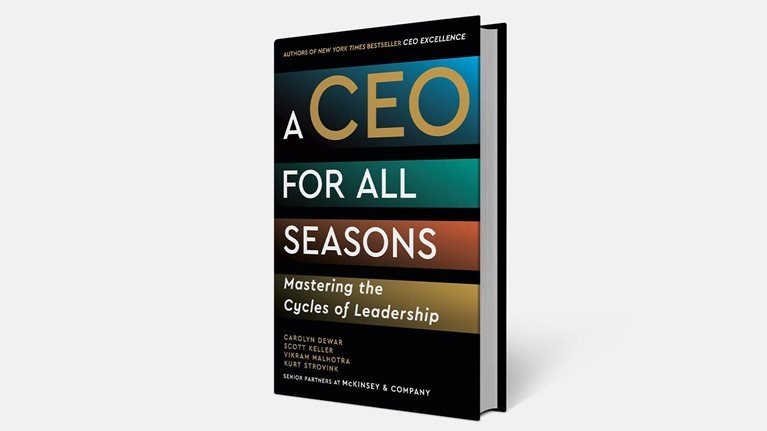
A CEO For All Seasons
Mastering the Cycles of Leadership
By Carolyn Dewar, Scott Keller, Vikram Malhotra, Kurt Strovink
A CEO for All Seasons by Carolyn Dewar, Scott Keller, Vikram Malhotra and Kurt Strovink positions itself as a lifecycle manual for the modern CEO, built on years of McKinsey research, extensive analytics and hundreds of conversations with top global leaders. Whereas their earlier work CEO Excellence examined what the best CEOs do, this book focuses on when and how they do it, arguing that leadership effectiveness is inherently cyclical. Drawing on a dataset of over 200 Fortune-level CEOs and case material spanning leaders such as Ken Frazier (Merck), Adena Friedman (Nasdaq), James Gorman (Morgan Stanley) and Steve Schwarzman (Blackstone), the authors present a structured, evidence-based approach to navigating the full arc of a CEO’s tenure.
The book’s central organising device, the Seasonal Framework, defines four distinct phases of the CEO journey: Stepping Up (Spring), Starting Strong (Summer), Staying Ahead (Autumn), and Sending It Forward (Winter). Each season brings its own mindset, leadership imperatives and predictable blind spots. “Spring” emphasises preparing for the role years in advance: zooming out from functional expertise to enterprise leadership, cultivating range and self-awareness, and developing the motivations and habits that signal readiness for the top job. “Summer” focuses on the high-stakes first year, a period the authors describe as “maximum attention and minimum knowledge”, requiring a balance between deep listening and decisive action. Early symbolic moments, first town halls, leadership reshuffles and initial strategic calls, set the tone for credibility and trust.
“Autumn” represents the long mid-tenure phase, where stability can give way to complacency. The authors warn of the “comfort trap” and urge CEOs to cultivate “constructive paranoia”, continuously learning, challenging orthodoxy and reinventing both themselves and their organisations. Here, leaders must shift from directing to enabling, build new S-curves before existing ones plateau, and renew culture before it ossifies into ritual and inertia. “Winter”, the final season, addresses succession and legacy. The book challenges CEOs to approach exit with intention, developing successors as a core responsibility, choosing their departure timing deliberately, and ensuring a clean, non-interfering handover that strengthens the institution. Importantly, it tackles the personal dimension of stepping aside, acknowledging the identity shock many CEOs face and encouraging them to define a meaningful next chapter.
Across all seasons, several timeless themes emerge. Humility is treated as a leadership superpower: the higher a leader rises, the more they must invite honest feedback, as it no longer arrives unprompted. Purpose acts as the CEO’s compass, anchoring decisions through crises, complex stakeholder demands and shifting market conditions. And adaptability is framed as the ultimate differentiator of enduring leadership. The authors describe the most successful CEOs as “context chameleons”: confident but not arrogant, decisive yet open to learning, able to move fluidly between bold action and thoughtful restraint. These meta-skills underpin six core CEO responsibilities the book highlights, vision, strategy, resource allocation, culture, organisation design and talent development, and are essential to delivering both short-term performance and long-term health.
Ultimately, A CEO for All Seasons contends that sustainable CEO success is not achieved through unrelenting intensity, heroic individualism or a single leadership style. Instead, it hinges on rhythm, renewal and self-awareness. By recognising the season they are in and adjusting their leadership accordingly, CEOs can avoid common pitfalls that derail even the most talented leaders: burnout, stagnation, misaligned transitions and eroded trust. The book’s practical value lies in transforming scattered executive wisdom into a cohesive framework that supports enduring, phase-appropriate leadership. Its conclusion is both pragmatic and hopeful: the CEOs who thrive longest are those who evolve with the seasons, steward their organisations with courage and humility, and ultimately leave their companies, and their successors, stronger than they found them.
Listen In
A Bit of Optimism
Leadership thinker and author, Simon Sinek, explores the emotional and behavioural foundations of effective leadership in A Bit of Optimism. Each episode features inspiring guests, from organisational psychologist Adam Grant to Airbnb CEO Ryan Chesky. Together, they explore themes that entrepreneur's know all too well: resilience, vulnerability, and long-term thinking.
Episode 193: The Future You Avoid Is Riskier Than the One You Face with LinkedIn co-founder Reid Hoffman
In this episode, Simon Sinek speaks with Reid Hoffman (serial entrepreneur, venture investor and co-founder of LinkedIn) about idealism, responsibility and the courage required to shape the future rather than fear it. Hoffman reflects on his childhood dreams of becoming a science-fiction author and his early desire to contribute to humanity’s progress. A particularly vivid anecdote recounts his 12-year-old plan to become Director of the CIA in order to “make the world more peaceful”, a dream swiftly abandoned after reading The Crimes of the U.S. Intelligence Agencies. From that point onward, Hoffman sought ways to influence society through ideas, considering academia before realising that entrepreneurship offered a more direct route to improving the human condition.
A central thread in the conversation is Hoffman’s lifelong fascination with science fiction, particularly the optimistic visions of the 1960s through early 1990s, which portrayed technology as a pathway to human flourishing. He contrasts this with today’s overwhelmingly dystopian narratives, arguing that society has lost its collective imagination about a future worth striving for. He warns that we cannot reach a desirable future simply by avoiding undesirable ones; as he puts it, you cannot drive from San Francisco to Los Angeles by planning only to avoid every accident and pothole. Sinek agrees, suggesting that the decline of optimistic science fiction may relate to the collapse of ideological competition after the Cold War, leaving Western societies to turn their anxieties inward rather than outward. They argue that leaders, creators and technologists have a responsibility to “preach” idealistic futures again, to remind us what we stand for and what we might build.
Hoffman’s optimism extends strongly to artificial intelligence, a subject he explores in his book Super Agency. He positions current fears around AI as a modern form of dystopian storytelling, compelling but often misguided. While he acknowledges that some concerns are valid, he argues that the majority of those building AI systems genuinely care about human welfare and that slowing progress dramatically (the “five-miles-an-hour” approach) is neither realistic nor safe given global competition. Instead, he advocates for rigorous testing, red-teaming, sensible regulation and an embrace of AI’s transformative power, particularly in medicine. He highlights one striking example: the realistic prospect of a high-quality AI medical assistant, accessible to anyone with a smartphone for under five dollars an hour, a breakthrough that could profoundly improve global health outcomes.
The conversation also explores how AI will reshape human skills. Sinek voices concern that outsourcing tasks to machines could erode essential human faculties, memory, resilience, problem-solving, much as calculators and digital diaries displaced older cognitive habits. Hoffman counters that while abilities will shift, they will not vanish; society will recalibrate standards, just as accountants evolved from manual arithmetic to strategic analysis. He predicts that AI will force education and workplaces to become more rigorous, not less, because assessment and skill-building can be personalised through low-cost, continuous, AI-driven testing. Both agree that the future is uncertain, but that equilibrium will emerge, as it always does, and that the key is to shape rather than shirk the responsibilities brought by new tools.
Throughout the episode, Hoffman’s idealism reappears in deeply personal ways. He recounts an early childhood memory of beating his grandfather at chess for the first time, not as a triumph over his grandfather but as a moment when “the world made sense” and he saw how systems worked, a metaphor Sinek links to Hoffman’s adult passion for understanding mechanisms for the benefit of others. They also discuss the founding of LinkedIn, where Hoffman’s “enemy” was not a rival company but an entrenched social norm: that posting a CV online was disloyal. He recalls the early days when employees feared being fired merely for having a LinkedIn profile, and his belief that democratising opportunity would empower individuals while ultimately benefiting employers as well. The episode concludes with Hoffman’s “life hack”: treating AI as a continual source of expert second opinions, whether for complex decisions or personal development, demonstrating his conviction that technology, used wisely, can expand human potential.


Meet the Team
We are also excited to announce the latest addition to the team, Lily.
At just 7 months old, Lily has climbed the ranks and quickly established herself as a highly motivated (and highly mobile) member of the team.
Her key responsibilities include: conducting stress tests on keyboards and attacking feet without warning.


In Association with the KPMG Board Leadership Centre

Sam Allen Associates is proud to partner with KPMG’s Board Leadership Centre in delivering the latest insight to Directors. KPMG has an established reputation as a trusted advisor to many of the UK’s board members and KPMG Connect On Board, which is part of the Board Leadership Centre, has been designed to help non-executive directors, both current and aspirant to find their next appointment.
To hear about Board appointments and to support your non-executive career you will be able to register here.
SAA is an accredited Board Reviewer

SAA has been evaluated by The Chartered Governance Institute UK & Ireland, which concluded that our Board Performance Reviews exemplify outstanding service and adhere to their Code of Practice. We continue to partner with clients across a range of ownership structures on value-adding Board Effectiveness Reviews.

School for CEOs is leading an immersive two-day programme, The Vital Few, taking place 18-19 March 2026. The programme is designed to expose new CEOs and Executives to potential derailers, learning through the experiences of those who have been there before, so that they can step up to CEO with confidence and eyes wide open.


